


Infusion claims usually fail in small ways. A nurse charts a start time and forgets the stop time. A biller reports two initial codes because two drugs were given. A claim goes out with an add-on hour for an infusion that ran 68 minutes.
Each of those is a different denial. Each one traces back to a rule that has been sitting in the CPT book or the Medicare Claims Processing Manual for more than a decade.
The 96365 CPT code is the anchor of that rule set. It is the base code for non-chemotherapy intravenous infusion, and nearly every other code in the 96360 to 96379 family attaches to it. Coding it correctly comes down to four questions: what counts as an infusion, which service is the initial one, how the clock is read, and what the record has to prove.
What CPT 96365 covers
The AMA descriptor for CPT 96365 is: intravenous infusion, for therapy, prophylaxis, or diagnosis (specify substance or drug); initial, up to 1 hour.
Three conditions have to be met at once. The route must be intravenous. The purpose must be therapeutic, prophylactic, or diagnostic. And the substance must fall outside two neighboring families: chemotherapy and highly complex biologic administration (96413 and related codes), and simple hydration (96360 and 96361).
Typical services reported with the 96365 procedure code include IV antibiotics such as ceftriaxone or vancomycin, intravenous iron, methylprednisolone, and diagnostic contrast or radiopharmaceutical infusions given for a test rather than for treatment.
One boundary trips people up more than the others. Some monoclonal antibodies and biologic response modifiers are billed as complex drug administration rather than as 96365, even when the patient has no cancer diagnosis. Noridian’s Part B guidance points out that anti-neoplastic agents used for autoimmune conditions still fall under the chemotherapy administration series. A CMS update effective January 2, 2025 to Publication 100-04, Chapter 12, Section 30.5 added that Medicare may weigh several factors when deciding whether the intensity of a complex administration service was met, instead of relying on the drug name alone. If your practice infuses biologics, that sentence is worth putting in front of your coding team.
Reading the clock: two thresholds decide the code
CPT treats an infusion of 15 minutes or less as a push. That makes 16 minutes the practical floor for 96365. Run an antibiotic for 12 minutes and the correct code is CPT code 96374, the IV push, not the initial infusion code.
The second threshold governs the add-on. CMS instructs that the “each additional hour” code may be reported only when the infusion interval runs more than 30 minutes past the one-hour increment. The agency’s own example: an infusion of a single drug lasting one hour and 45 minutes is reported as the initial code plus one add-on unit for the remaining 45 minutes.
Documented infusion time | Correct reporting |
12 minutes | 96374 |
40 minutes | 96365 |
1 hour 20 minutes | 96365 only |
1 hour 45 minutes | 96365 + 96366 x 1 |
2 hours 40 minutes | 96365 + 96366 x 2 |
That third row is where money quietly leaks in both directions. Practices that round up bill an add-on they cannot defend. Practices that round down lose a paid unit at 2 hours 35 minutes because nobody recorded the actual stop time.
One initial code per encounter
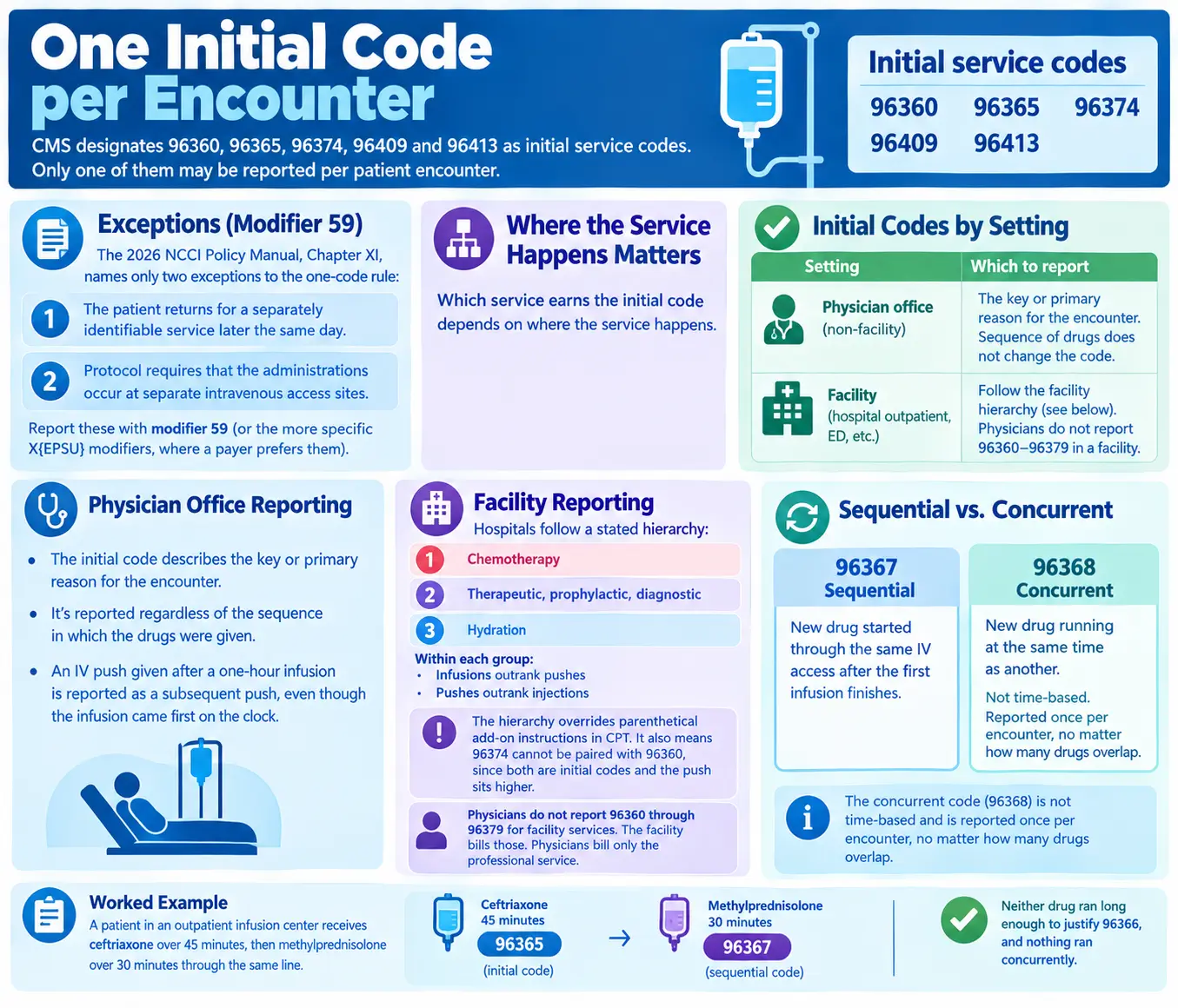
CMS designates 96360, 96365, 96374, 96409, and 96413 as initial service codes. Only one of them may be reported per patient encounter. The 2026 NCCI Policy Manual, Chapter XI, repeats the rule and names the only two exceptions: the patient returns for a separately identifiable service later the same day, or protocol requires that the administrations occur at separate intravenous access sites. Those exceptions are reported with modifier 59 (or the more specific X{EPSU} modifiers, where a payer prefers them).
Which service earns the initial code depends on where the service happens.
Physician office reporting
In the non-facility setting, the initial code describes the key or primary reason for the encounter, and it is reported regardless of the sequence in which the drugs were given. An IV push administered after a one-hour infusion is reported as a subsequent push, even though the infusion happened to come first on the clock.
Facility reporting
Hospital outpatient departments follow a stated hierarchy instead. Chemotherapy outranks therapeutic, prophylactic, and diagnostic services, which outrank hydration. Within that order, infusions outrank pushes, and pushes outrank injections. The hierarchy overrides parenthetical add-on instructions in CPT. It also means 96374 cannot be paired with 96360, since both are initial codes and the push sits higher.
Physicians do not report 96360 through 96379 for services furnished in a facility such as a hospital outpatient department or emergency department. The facility bills those. Physicians in that setting bill only the professional service.
Sequential versus concurrent
96367 covers a new drug started through the same IV access after the first infusion finishes. 96368 covers a new drug running at the same time as another. The concurrent code is not time-based and is reported once per encounter no matter how many drugs overlap.
Worked example. A patient in an outpatient infusion center receives ceftriaxone over 45 minutes, then methylprednisolone over 30 minutes through the same line. Report 96365 for the antibiotic and 96367 for the steroid. Neither drug ran long enough to justify 96366, and nothing ran concurrently.
Documentation that survives review
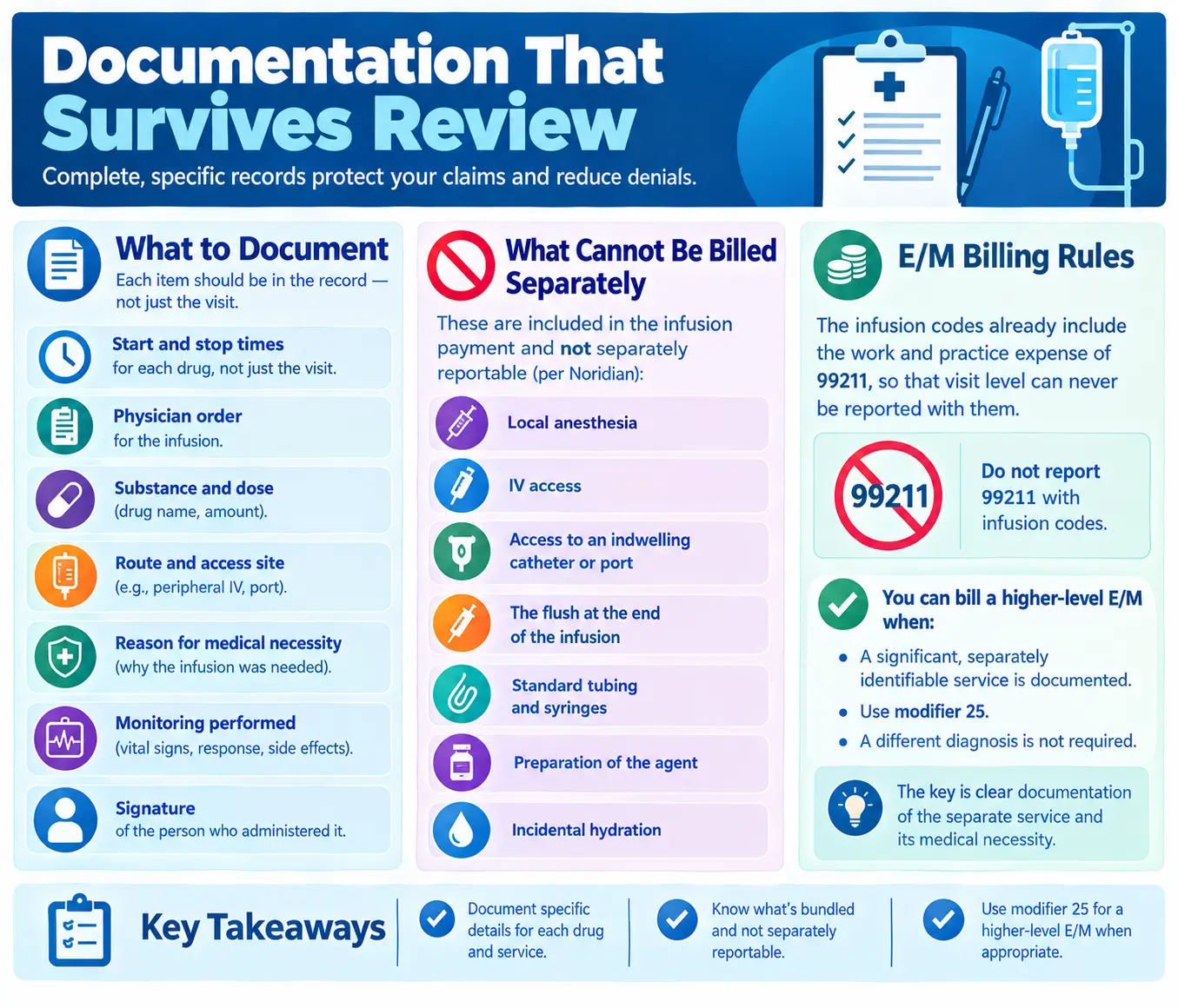
Start and stop times are the foundation, and they need to exist for each drug, not just for the visit. Beyond timing, the record should carry the physician order, the substance and dose, the route and access site, the reason the infusion was medically necessary, monitoring performed, and the signature of the person who administered it.
Just as important is knowing what cannot be billed alongside the administration. Noridian lists the following as included in the infusion payment and not separately reportable: local anesthesia, IV access, access to an indwelling catheter or port, the flush at the end of the infusion, standard tubing and syringes, preparation of the agent, and incidental hydration.
The infusion codes were also valued to include the work and practice expense of 99211, so that visit level is never reported with them. A higher-level E/M can be billed with modifier 25 when a significant, separately identifiable service is documented. A different diagnosis is not required.
96365 CPT code reimbursement in 2026
Medicare pays for the administration and the drug on separate lines. The 96365 CPT code prices only the administration. The drug carries its own HCPCS J-code and is generally paid at average sales price plus 6 percent.
CMS finalized two conversion factors for CY 2026 in the Physician Fee Schedule final rule (CMS-1832-F, released October 31, 2025): $33.5675 for clinicians in a qualifying advanced alternative payment model and $33.4009 for everyone else. Applied to the CY 2026 relative values, the national amounts for the therapeutic infusion family are:
Code | Description | 2026 national Medicare amount |
96365 | Initial IV infusion, up to 1 hour | $67.14 |
96366 | Each additional hour | $21.38 |
96367 | Additional sequential infusion, up to 1 hour | $29.73 |
96368 | Concurrent infusion | $20.71 |
Facility and non-facility practice expense values are identical for these codes, so the facility and non-facility amounts match. Every MAC then applies geographic practice cost indices, which moves the local allowable up or down from the national figure.
Hospital outpatient billing changed meaningfully this year. 96365 maps to APC 5692 under the Outpatient Prospective Payment System. In the CY 2026 OPPS final rule (CMS-1834-FC), CMS extended its site-neutral payment method to drug administration services furnished in excepted off-campus provider-based departments, paying codes assigned to APCs 5691 through 5694 at the Physician Fee Schedule equivalent, roughly 40 percent of the OPPS rate. Rural sole community hospitals are exempt. CMS estimated the policy would reduce OPPS spending by $290 million in CY 2026, with $220 million of that accruing to the program and $70 million to beneficiaries. Any hospital running an off-campus outpatient infusion center that bills with modifier PO should have already modeled this.
Home infusion sits on a third schedule entirely. For CY 2026, CMS set the national rate for G0068, covering professional services for administering anti-infective, pain management, chelation, pulmonary hypertension, or inotropic infusion drugs in the patient’s home, at $190.22. The initial home visit code G0088 pays $231.36.
Modifiers and drug-line details
Three modifier decisions account for most preventable infusion denials.
- Modifier 59 or an X{EPSU} modifier on the second initial code, and only when a separate encounter or a second IV site is documented.
- Modifier 25 on a separately identifiable E/M service performed the same day.
- Modifier JW or JZ on every separately payable single-dose container drug line. JW reports the discarded amount; JZ attests there was none. CMS made JZ mandatory for dates of service on or after July 1, 2023, and began returning single-dose drug claims as unprocessable without one of the two from October 1, 2023.
Where infusion claims usually break
Look at your denial file and the same handful of causes tend to repeat. Missing stop times. A second initial code billed for a second drug. An add-on hour reported at 1 hour 20 minutes. Hydration billed at 22 minutes when the minimum duration is 31 minutes, or billed at all when the fluid was only keeping the line open during a therapeutic infusion. A J-code line submitted with neither JW nor JZ.
None of these are judgment calls. They are documentation and edit failures, which means they can be caught with a nursing flowsheet that forces a stop time and a pre-bill edit that counts initial codes per encounter. Practices that fix the flowsheet first usually find the coding takes care of itself, because the 96365 CPT code and its add-ons are almost entirely determined by two numbers the clinician already knows: when the infusion started and when it stopped.