


The CPT code for Pap smear may be 88142 or 88175 for laboratory cytology, but the correct choice depends on how the sample is processed and examined. The office’s collection service, cytology analysis, and HPV testing represent different work. Medicare separately recognizes Q0091 for eligible screening specimen collection, preparation, and conveyance to the laboratory.
Accurate Pap smear coding begins by identifying the completed service, the performing provider, and whether testing was ordered for screening or diagnostic evaluation.
Choosing the CPT code for Pap smear
A Pap test, also called a Papanicolaou test, involves cervical cytology. The laboratory’s preparation and examination method determines which cytopathology code applies. Aetna’s Cervical Cancer Screening and Diagnosis policy, reviewed July 22, 2026, lists these distinctions. The table summarizes the services under physician oversight.
CPT code | Laboratory service represented |
88142 | Liquid-based, thin-layer preparation examined manually under physician oversight |
88174 | Liquid-based, thin-layer preparation screened using an automated system |
88175 | Automated screening of a liquid-based preparation followed by manual rescreening or review |
88150 | Conventional cervical or vaginal slides examined manually |
88164 | Manually examined conventional slides reported using the Bethesda System |
88141 | Cervical or vaginal cytology requiring physician interpretation |
Do not select 88175 merely because the order says “ThinPrep.” Labcorp’s test directory identifies its liquid-based Pap test, number 192005, with 88142, while its image-guided Pap/HPV order, number 199330, includes 88175. The brand name alone does not establish the laboratory’s screening method.
When physician interpretation is separately reportable
CPT 88141 requires the cytopathology interpretation described by that code. An ordering clinician’s discussion of the laboratory report does not establish that service.
Labcorp distinguishes referred pathologist review from routine quality-control review, which it excludes from its additional interpretation charge. Confirm that the required interpretation occurred before adding a separate code.
Pap smear with HPV testing: identify both services
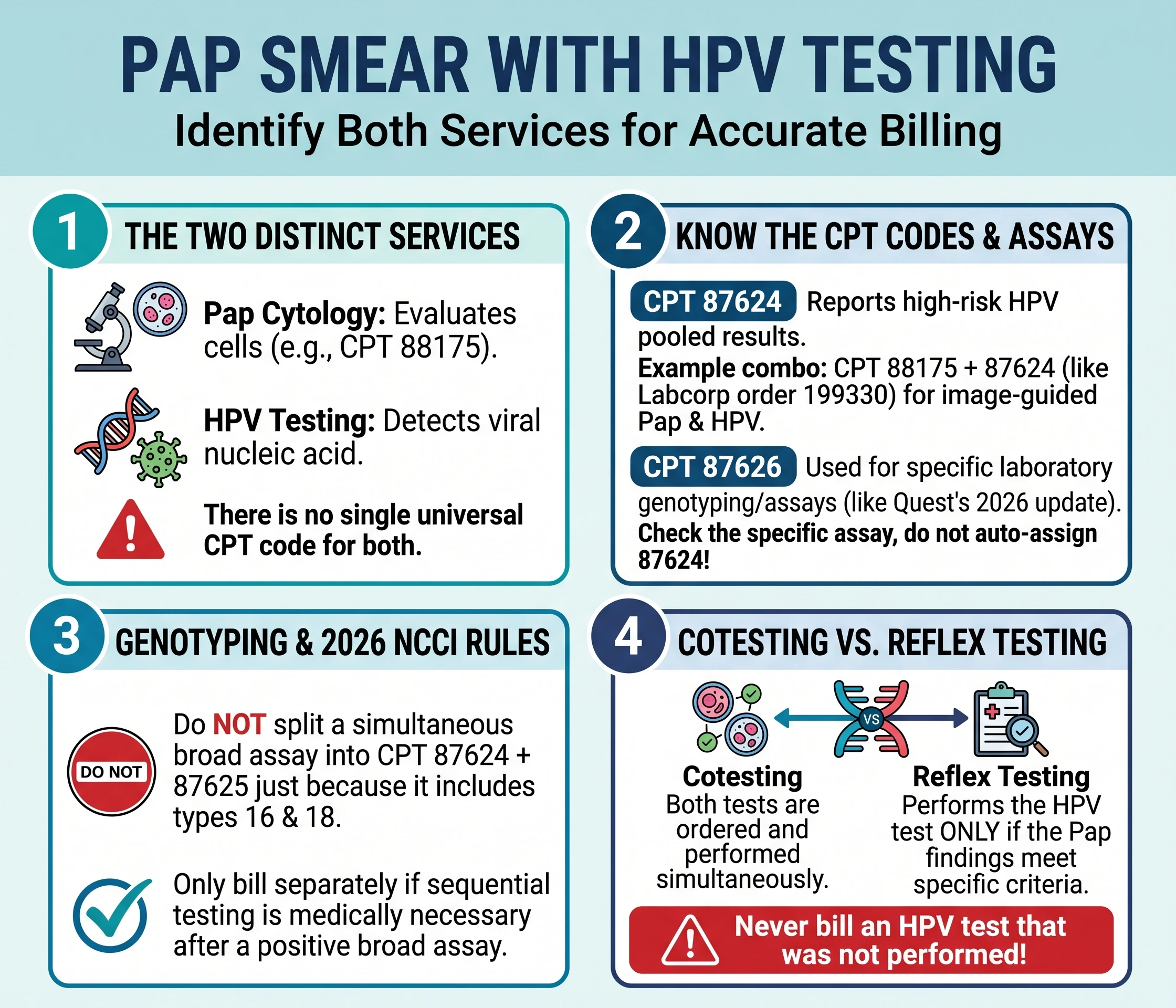
A Pap test and an HPV test examine different things. Cytology evaluates cells; HPV testing detects viral nucleic acid. Consequently, there is no single universal Pap smear with HPV CPT code covering every testing method.
CPT 87624 describes testing that reports a pooled result for high-risk HPV types. A verified example is Labcorp order 199330, which lists 88175 and 87624 for image-guided Pap cytology with its Aptima HPV assay. That combination applies to the specified testing, subject to payer requirements.
The HPV assay also matters. Quest Diagnostics’ IntelliTest update, effective February 23, 2026, lists 87626 for certain Pap/HPV orders. Check the current laboratory assay and its genotype reporting rather than assigning 87624 to every HPV test.
Genotyping creates another billing distinction. CMS’s 2026 NCCI manual prohibits splitting a simultaneous broad HPV assay into 87624 plus 87625 merely because the assay includes types 16 and 18. Separate, medically necessary sequential testing after a positive broad assay can support different reporting when guideline criteria are met.
Distinguish cotesting from reflex testing. Cotesting orders both tests; a reflex order performs the additional test only when specified criteria are met. Quest’s CPT Code Changes 2026 document illustrates reflex HPV testing triggered by particular Pap findings. Do not bill an HPV test that was never performed.
Medicare Pap smear codes and screening coverage
Medicare screening claims use HCPCS Level II codes for several services. These are sometimes described as “Medicare Pap smear CPT codes,” although the code systems differ.
CMS’s Screening Pap Tests & Pelvic Exams booklet, dated October 2024, separates laboratory screening, physician interpretation, and collection.
HCPCS code | Screening service |
Q0091 | Collecting and preparing the cervical or vaginal sample and conveying it to the laboratory |
G0145 | Liquid-based cytology with automated screening and manual rescreening |
G0124 | Physician interpretation of liquid-based, thin-layer screening cytology |
P3001 | Physician interpretation of screening cervical or vaginal Pap smears, up to three smears |
G0101 | The covered pelvic and clinical breast screening examination |
These are selected screening codes. Q0091 does not describe diagnostic specimen collection. G0124 and P3001 represent interpretation, so they cannot substitute for collection or routine laboratory screening. G0101 requires its own examination and documentation criteria.
Check frequency before submitting the claim
Medicare.gov’s Cervical & vaginal cancer screenings coverage page states that screening Pap tests are generally covered every 24 months. Coverage is every 12 months for qualifying high-risk patients or patients of childbearing age with an abnormal Pap test during the preceding 36 months. Check benefit eligibility and the documented risk criteria.
For standard screening, Medicare’s claims manual requires 23 full months after the month of the last covered test; the annual pathway uses 11 full months. Verify the next eligible date before scheduling. A new calendar year does not automatically reset the benefit.
HPV screening has a separate rule. In its July 9, 2026 MLN Connects newsletter, CMS reaffirmed G0476 for covered HPV screening in asymptomatic patients ages 30–65, once every five years, performed with a Pap test. Do not automatically substitute 87624 for this Medicare preventive benefit.
For example, an eligible Medicare screening encounter could involve Q0091 from the collecting office and G0145 from the laboratory, assuming the documented laboratory method matches. The office should not add 88175 simply because it collected and shipped the sample.
Commercial insurance and office visit billing
Commercial insurance Pap smear billing rules require a plan-specific check.
Moda Health’s Gynecologic or Annual Women’s Exam Visit & Use of Q0091 policy, updated May 13, 2026, directs commercial claims to the age-appropriate preventive medicine visit code and rejects Q0091. This is Moda’s policy; it should not be presented as a rule for every commercial insurer.
The same policy permits a separate office E/M service with modifier 25 when a significant, separately identifiable problem requires work beyond the preventive service. A minor finding alone does not justify another visit code. Documentation must support the additional evaluation.
Before billing, distinguish the preventive visit, specimen collection, laboratory analysis, and any separately supported problem-oriented service. This prevents the office’s charge entry from treating every component as separately payable.
Diagnosis codes must explain why testing occurred
Screening and diagnostic testing have different purposes. The FY 2027 ICD-10-CM Official Guidelines, effective October 1, 2026, distinguish testing apparently well individuals from testing prompted by signs or symptoms. They also allow an identified condition to be reported additionally when discovered during screening.
Relevant diagnosis codes include:
- Z12.4: Cervical cancer screening.
- Z11.51: HPV screening.
- Z01.419: Routine gynecological examination without abnormal findings.
These codes are not interchangeable. Follow the encounter documentation, applicable sequencing instructions, and payer requirements. The official guidelines specifically state that an additional screening code is unnecessary when screening is inherent in a routine examination, such as a Pap test during a routine pelvic examination.
For diagnostic Pap tests, CMS’s NCD 190.2, effective June 19, 2006, recognizes prior abnormal Pap results and significant gynecological findings among covered indications. Document the actual reason for testing and medical necessity; do not replace it with a screening diagnosis merely to obtain preventive coverage.
Pap smear documentation requirements
A useful claim review connects the clinician’s order to the laboratory report. Confirm the following against the requisition, clinical history, and completed testing:
- The reason for testing and relevant symptoms or prior abnormal findings.
- Previous screening dates and risk factors when they affect eligibility.
- Specimen source, collection date, and ordering clinician.
- Whether HPV testing was ordered concurrently or conditionally.
- The actual cytology method, completed tests, and any separate physician interpretation.
Mayo Clinic Laboratories’ DTHPV catalog specifies patient identifiers, specimen source, collection date, ordering clinician, and pertinent history on the requisition. Labcorp likewise requests relevant clinical history, including prior abnormal Pap results. These details help the laboratory process the intended order.
Pap smear reimbursement tips that address claim errors
Payment depends on the billed component. CMS’s Medicare Claims Processing Manual, chapter 18, separates laboratory screening paid under the Clinical Laboratory Fee Schedule from collection and specified interpretation services paid under the Physician Fee Schedule. Check the applicable schedule for the service date and setting before estimating reimbursement.
For commercial claims, compare payment with the contracted allowance and the plan’s bundling rules. A published laboratory rate does not establish the collecting office’s payment. Review the denied line and explanation before changing a code. For example, Moda’s published Q0091 rejection is a code-validity issue for its commercial plans; supplying additional clinical notes would not change that policy.
Two checks deserve particular attention:
- Duplicate methods: Do not stack alternative cytology codes for the same analysis. CMS’s January 1, 2026 NCCI pathology guidance requires the code to match the completed service and prohibits unbundling.
- Unsatisfactory specimens: Medicare’s claims manual describes Q0091 with modifier 76 for repeat collection by the same physician after an uninterpretable screening specimen. Retain the laboratory’s unsatisfactory result and the repeat-collection documentation.
Medicare.gov states that eligible screening services have no patient charge when the provider accepts assignment. Verify that all coverage conditions are satisfied before promising a patient that an encounter will have no out-of-pocket cost.
The correct CPT code for Pap smear follows the documented laboratory method and service performed. Keep collection, cytology, HPV testing, and interpretation distinct, then apply the payer’s coverage and payment rules. A claim supported by the order, report, and screening history is easier to defend than one built around a default code.