

The 97110 CPT code is used to report therapeutic exercises performed to improve a patient’s strength, endurance, range of motion, or flexibility. It is one of the commonly used procedure codes in physical therapy and rehabilitation services.
Although therapeutic exercise is a routine part of rehabilitation, accurate billing requires more than recording the exercises performed. Healthcare providers must document medical necessity, direct treatment time, skilled intervention, and the patient’s response to treatment.
Errors involving timed units, incomplete documentation, or incorrect modifiers can result in claim denials, reimbursement reductions, or payment reviews.
This guide explains the CPT 97110 description, Medicare billing requirements, documentation standards, modifier usage, reimbursement considerations, and practical steps for submitting accurate claims.
What is CPT code 97110?
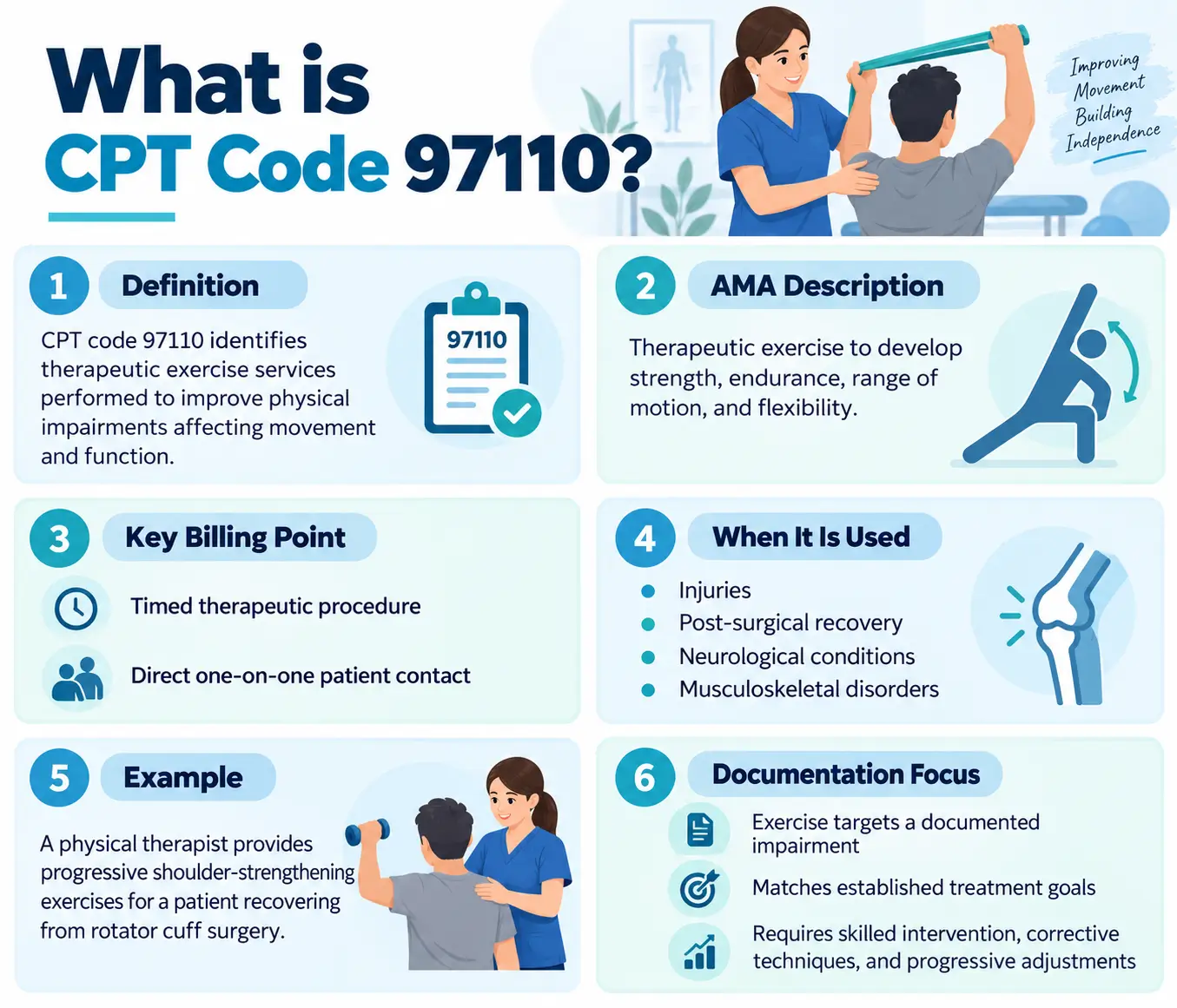
CPT code 97110 identifies therapeutic exercise services performed to improve physical impairments affecting movement and function.
The American Medical Association (AMA) describes this procedure as therapeutic exercise directed at developing strength, endurance, range of motion, and flexibility. The code represents a timed therapeutic procedure involving direct, one-on-one patient contact.
Therapists typically use this code when patients require skilled exercise interventions following injuries, surgeries, neurological conditions, or musculoskeletal disorders.
For example, a physical therapist may provide progressive shoulder-strengthening exercises to a patient recovering from rotator cuff surgery. When the intervention involves professional evaluation, corrective techniques, and progressive adjustments, it may qualify for CPT code 97110.
The exercises should target a documented impairment and align with the patient’s established treatment goals.
CPT 97110 code description
Code information | Description |
CPT code | 97110 |
Procedure category | Therapeutic exercise |
Billing unit | Each 15 minutes |
Treatment approach | Direct one-on-one patient contact |
Primary objectives | Strength, endurance, flexibility, and range of motion |
Common setting | Physical and occupational therapy |
Code classification | Time-based therapeutic procedure |
The 97110 CPT code description applies to therapeutic exercise performed in one or more body areas.
A provider cannot justify billing based solely on the presence of exercise equipment or the number of repetitions completed. The intervention must involve skilled treatment, and the billed time must satisfy the applicable payer’s requirements.
What services are covered under CPT 97110?
Therapeutic exercises may address several physical limitations. The appropriate intervention depends on the patient’s evaluation, diagnosis, and functional limitations.
Strengthening exercises
Strengthening exercises help patients improve muscle performance after injury, surgery, or periods of reduced activity.
Examples include progressive resistance exercises, controlled weight training, and resistance-band activities.
Range-of-motion and flexibility exercises
Range-of-motion exercises are used when joint restrictions interfere with normal movement. Flexibility exercises may address muscle tightness that limits functional activity.
Therapists may provide assisted movement, stretching instruction, or carefully progressed mobility exercises when skilled intervention is necessary.
Endurance training
Therapeutic exercise may also focus on improving muscular endurance, particularly when weakness or fatigue limits the patient’s ability to perform repeated movements.
A patient recovering from knee surgery, for example, may require progressive lower-extremity exercise to improve tolerance for walking and standing.
Not every exercise performed during a therapy visit qualifies for reimbursement. General fitness activities, independently performed exercises, and services that do not require skilled therapeutic involvement may fail medical necessity requirements.
CPT 97110 billing guidelines and time requirements
The 97110 billing code is a time-based procedure. Providers must calculate units according to the actual direct treatment minutes and the patient’s insurance requirements.
For Medicare Part B, therapeutic exercise billing generally follows the 8-minute rule.
Under this rule, a minimum of eight minutes of qualifying timed therapy services is needed to support one billable unit. When multiple timed procedures are performed during the same treatment session, the total timed treatment minutes determine the number of units available for allocation.
How many minutes are required for CPT 97110?
The following chart shows Medicare’s unit calculation for timed therapy procedures.
Total timed treatment minutes | Billable units |
0–7 minutes | 0 |
8–22 minutes | 1 |
23–37 minutes | 2 |
38–52 minutes | 3 |
53–67 minutes | 4 |
68–82 minutes | 5 |
These ranges apply to the combined time spent performing qualifying timed procedures, rather than independently rounding every procedure to the next unit.
For example, suppose a therapist provides 24 minutes of therapeutic exercise under 97110 and 16 minutes of neuromuscular reeducation under 97112.
The total timed treatment duration is 40 minutes, supporting three units under Medicare’s rules.
The appropriate allocation is two units of CPT 97110 and one unit of CPT 97112.
Reporting three units for therapeutic exercise and another unit for neuromuscular reeducation would incorrectly increase the units beyond the documented treatment time.
Commercial insurers may apply different timing policies. Providers should verify the payer’s rules before submitting claims.
CPT 97110 documentation requirements
Accurate therapeutic exercise documentation must establish why the intervention was medically necessary and how it contributed to the patient’s rehabilitation goals.
A complete treatment record should identify the patient’s impairment, the intervention provided, the skilled involvement of the therapist, and the patient’s response.
Document the medical necessity
The initial evaluation should identify functional limitations supported by clinical findings.
For example, a patient recovering from an ankle injury may demonstrate restricted dorsiflexion, reduced plantar-flexor strength, and difficulty climbing stairs.
The treatment plan should connect these limitations to appropriate therapeutic exercises and measurable functional goals.
A diagnosis alone does not establish the medical necessity of every treatment session. Continued services must remain clinically justified.
Record the therapeutic interventions
Daily treatment notes should describe the exercises performed and any meaningful modifications.
Useful documentation includes exercise type, resistance, repetitions, progression, patient tolerance, and the skilled assistance provided.
For Medicare, the treatment note must support the total timed treatment minutes and total treatment time. Recording intervention-specific minutes also helps demonstrate proper code allocation.
Include the patient’s response
Patient response provides evidence of treatment effectiveness and supports decisions about progression.
A note stating only that the patient tolerated treatment offers limited information.
A stronger record may describe improved movement, reduced compensatory patterns, changes in resistance tolerance, or the need for continued therapist assistance.
Example of CPT 97110 documentation
The following is an illustrative treatment note, not an actual patient record.
Sample daily treatment note
Treatment: Therapeutic exercise, CPT 97110
Duration: 25 minutes of direct one-on-one treatment
Interventions: Seated knee extensions with progressive resistance, controlled sit-to-stand strengthening, and assisted knee flexion exercises.
Skilled services: Therapist adjusted resistance, corrected compensatory movement, and provided verbal and tactile cues.
Patient response: Completed prescribed exercises with mild fatigue and improved movement control.
Medical necessity: Continued skilled therapeutic exercise is required to address lower-extremity weakness and restricted knee mobility affecting stair negotiation.
Documentation should accurately reflect the services performed. Templates may help maintain consistency, but automatically repeated treatment notes can obscure changes in patient status.
For Medicare outpatient therapy, progress reports generally must be completed at least once every 10 treatment days.
Does CPT 97110 need a modifier?
Modifier requirements depend on the treatment discipline, provider participation, insurance coverage, and specific billing circumstances.
GP modifier for CPT 97110
The GP modifier identifies services furnished under an outpatient physical therapy plan of care.
For applicable Medicare physical therapy claims, CPT 97110 is typically submitted with GP.
When therapeutic exercise is provided under an occupational therapy plan of care, the appropriate therapy modifier is generally GO.
CQ modifier for physical therapist assistants
Modifier CQ identifies services furnished in whole or in part by a physical therapist assistant when Medicare’s applicable de minimis standard is met.
CMS generally requires modifier CQ when a therapy assistant independently provides more than 10% of the service, subject to specific exceptions for allocating units.
Medicare pays applicable assistant-furnished services at 85% of the otherwise applicable payment rate.
Modifier 59 and XU
Modifier 59 or XU may be appropriate when separately reportable services are performed during distinct treatment intervals and an applicable National Correct Coding Initiative (NCCI) edit permits a modifier.
These modifiers should never be added automatically to obtain payment.
The documentation must support separate services, and the current payer edits must allow the reported combination.
Can CPT 97110 be billed with other therapy codes?
Therapists frequently perform several different interventions during the same visit.
CPT 97110 may be reported with another therapy code when each service is medically necessary, correctly classified, separately documented, and supported by nonoverlapping treatment time.
CPT 97110 vs 97112, 97140, and 97530
CPT code | Primary purpose |
97110 | Therapeutic exercise for strength, endurance, flexibility, and range of motion |
97112 | Neuromuscular reeducation addressing movement, balance, coordination, posture, or proprioception |
97140 | Manual therapy techniques |
97530 | Therapeutic activities involving dynamic functional performance |
The distinction between 97110 and 97530 is particularly important.
Therapeutic exercise generally targets specific physical impairments, such as muscle weakness or restricted joint mobility.
Therapeutic activities emphasize functional tasks involving dynamic movement.
A therapist may use resisted knee extensions to improve quadriceps strength under 97110, then provide task-specific lifting activities under 97530.
Each service must meet its code definition and billing requirements.
For 97110 and 97112 billed together, separate treatment intervals must support the reported services. The same time cannot be counted toward both procedures.
Similarly, 97110 and 97140 may be billed during one visit when the services qualify for separate reporting. Providers should review current NCCI edits, including any required modifier and restrictions. CMS updates its procedure-to-procedure edits quarterly.
CPT 97110 reimbursement rates in 2026
CPT 97110 reimbursement depends on the payer, geographic location, billing setting, provider arrangement, and applicable payment policies.
Medicare reimbursement is determined through the relevant payment methodology, including the Medicare Physician Fee Schedule when applicable.
There is no single nationwide reimbursement amount appropriate for every 97110 claim.
Medicare reimbursement considerations
Medicare applies a multiple procedure payment reduction (MPPR) to certain therapy services performed for the same patient on the same day.
Under this policy, the practice expense component of subsequent eligible therapy services is reduced by 50%. The reduction does not mean that the entire payment for every additional procedure is cut in half.
For calendar year 2026, CMS established the outpatient therapy KX modifier threshold at $2,480 for physical therapy and speech-language pathology combined, with a separate $2,480 threshold for occupational therapy.
Services above the applicable threshold may remain payable when medically necessary, properly documented, and submitted with the required KX modifier.
The 2026 targeted medical review threshold remains $3,000 for each applicable therapy category.
Commercial insurance reimbursement depends on negotiated fee schedules, benefit limitations, authorization requirements, and payer-specific policies.
Common CPT 97110 billing errors
One frequent mistake is calculating units separately for every timed procedure without considering the combined treatment minutes.
Other problems arise when documentation fails to explain the professional skill required for therapeutic exercise.
For example, repeatedly documenting the same exercises without explaining progression, patient response, or continued medical necessity may create difficulties during a payment review.
Billing staff should also watch for unsupported modifier 59 usage, missing therapy modifiers, overlapping treatment minutes, expired authorizations, and incorrect treatment classifications.
A useful claim review compares the billed procedure, documented intervention, recorded minutes, and applicable payer requirements before submission.
CMS identified therapy claims involving CPT 97110 and other rehabilitation codes as an approved Recovery Audit Contractor review topic in April 2026, focusing on medical necessity, documentation, coding, and KX modifier use.
How to improve CPT 97110 claim accuracy
Accurate billing begins with treatment documentation that supports the code selected.
Therapists should connect each intervention to an identified functional impairment, document the skilled services delivered, and record changes in patient performance.
Billing teams should verify treatment minutes, modifier requirements, active coverage, authorization conditions, and code combinations before claim submission.
For Medicare claims, particular attention should be given to the 8-minute rule, therapy thresholds, assistant participation, and NCCI edits.
Regular review of denied claims can help identify whether errors originate in documentation, code selection, authorization verification, or claim processing.
Conclusion
The 97110 CPT code represents skilled therapeutic exercise intended to improve strength, endurance, range of motion, or flexibility.
Successful billing depends on accurate treatment time, appropriate unit calculation, clinical documentation, medical necessity, and correct modifier usage.
Healthcare providers and medical billers should apply current Medicare guidance and individual payer requirements rather than assuming that every insurer follows identical rules.
Accurate documentation and coding for therapeutic exercise can help minimize preventable claim denials and ensure rehabilitation services are reported correctly.
Zimerov Ertover
I don’t even understand how I finished up here, but I assumed this submit used to be great. I don’t realize who you are however certainly you are going to a well-known blogger in the event you are not already 😉 Cheers!