

Billing insurance for Applied Behavior Analysis (ABA) therapy requires an understanding of insurance coverage, provider credentialing, prior authorization, medical coding, and claim submission requirements. Because ABA services often involve multiple professionals, recurring treatment sessions, and ongoing clinical assessments, billing errors can create significant reimbursement delays.
Healthcare providers must also account for differences between commercial insurance plans, Medicaid programs, and other payers. Each insurer may establish specific requirements for treatment authorization, documentation, provider qualifications, and reimbursement.
Understanding how to bill insurance for ABA therapy helps behavioral health professionals submit accurate claims, reduce administrative problems, and maintain consistent revenue cycle operations.
This guide explains the ABA therapy billing process, including insurance verification, commonly used CPT codes, documentation requirements, claim submission, denial management, and payment follow-up.
What is ABA therapy billing?
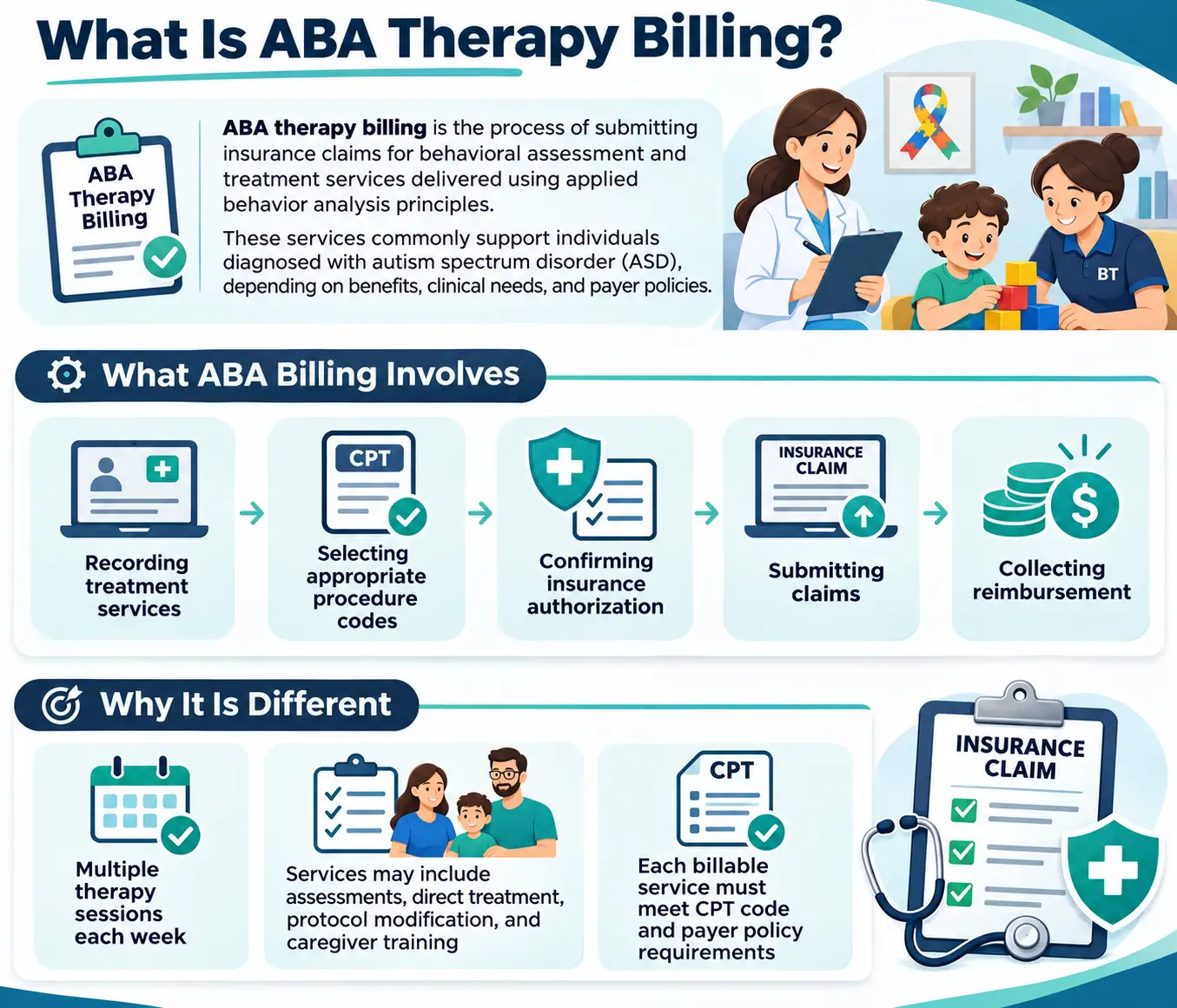
ABA therapy billing is the process of submitting insurance claims for behavioral assessment and treatment services delivered using applied behavior analysis principles. These services commonly support individuals diagnosed with autism spectrum disorder (ASD), although coverage depends on the patient’s benefits, clinical needs, and applicable insurance policies.
ABA billing involves recording treatment services, selecting appropriate procedure codes, confirming insurance authorization, submitting claims, and collecting reimbursement.
Unlike some medical specialties where services occur during occasional appointments, ABA treatment may involve multiple sessions each week. Services can include assessments performed by qualified healthcare professionals, direct treatment delivered by behavior technicians, treatment protocol modifications, and caregiver training.
Each billable service must meet the requirements of the applicable CPT code and payer policy.
How to bill insurance for ABA therapy: Step-by-step process
Step 1: Verify the patient’s insurance coverage
The ABA insurance billing process begins before treatment services are provided. Insurance eligibility verification confirms whether the patient’s coverage is active and whether ABA therapy is included in the benefits.
Billing staff should determine whether the patient has commercial insurance, Medicaid, TRICARE, or multiple insurance plans.
Verification should establish whether the provider is in-network, whether the requested service is covered, what authorization requirements apply, and whether the family has any deductible, copayment, or coinsurance obligations.
Coverage limitations may also apply to specific treatment settings, provider types, or service categories.
For example, a patient might have active insurance coverage but require additional approval before receiving technician-delivered ABA treatment. Providing services without the required authorization can result in denied claims.
Insurance verification should be repeated when coverage changes, particularly at the beginning of a new benefit year.
Step 2: Complete provider credentialing and enrollment
Before submitting ABA medical billing claims, providers must satisfy the applicable insurer’s credentialing and enrollment requirements.
Board Certified Behavior Analysts (BCBAs), assistant behavior analysts, and behavior technicians may have different qualifications and billing responsibilities.
A BCBA certification does not automatically establish eligibility to bill every insurance plan. Providers may also need state licensure, payer enrollment, an appropriate National Provider Identifier (NPI), and an effective participation agreement.
The billing organization must correctly identify the billing provider, rendering provider, and supervising professional when required.
For group practices, the relationship between the individual provider and the billing organization must also be established with the payer.
Submitting claims under an improperly enrolled provider can create payment disputes even when the underlying treatment was clinically appropriate.
Step 3: Obtain ABA prior authorization
Many insurers require prior authorization before covering ABA assessments or treatment.
The authorization process generally involves submitting clinical information supporting the requested services. This may include the patient’s diagnosis, assessment findings, treatment goals, recommended service frequency, and clinical justification.
Some payers authorize an initial assessment separately from ongoing treatment. Following the assessment, the provider may need to submit a treatment plan before direct therapy can begin.
Authorization records should clearly identify the approved service codes, effective dates, authorized units, and applicable provider or location restrictions.
TRICARE’s Autism Care Demonstration, for example, requires referrals and authorization for ABA services and generally uses six-month treatment authorization periods.
Billing teams should monitor approved units throughout the authorization period instead of waiting until claims are rejected or denied.
An authorization confirms approval under specified conditions, but it does not guarantee payment if other claim requirements are not satisfied.
ABA therapy billing codes and their uses
Accurate ABA billing and coding depend on selecting CPT codes that describe the services actually performed.
The following table summarizes commonly used codes applicable to services through December 31, 2026.
CPT code | ABA service description |
97151 | Behavior identification assessment performed by a qualified healthcare professional |
97152 | Supporting behavior identification assessment performed by a technician |
97153 | Individual adaptive behavior treatment delivered according to an established protocol |
97154 | Group adaptive behavior treatment delivered by a technician |
97155 | Individual adaptive behavior treatment involving protocol modification by a qualified professional |
97156 | Family adaptive behavior treatment guidance |
97157 | Multiple-family group adaptive behavior treatment guidance |
97158 | Group adaptive behavior treatment with protocol modification by a qualified professional |
These services are generally reported in 15-minute units under the 2026 CPT code set.
For example, CPT 97153 is commonly used when an appropriately qualified technician provides direct treatment to one patient according to an established treatment protocol.
CPT 97155 is different because it involves professional clinical work associated with treatment protocol modification. Routine administrative supervision does not automatically qualify.
Certain specialized destructive-behavior assessment and treatment services may also be reported using Category III codes 0362T and 0373T when all applicable conditions are satisfied.
Important 2027 coding update: The American Medical Association has approved revisions to codes 97151 through 97158, additional adaptive behavior codes, and the deletion of 0362T and 0373T effective January 1, 2027. Providers must use the code set applicable to the actual date of service.
How to calculate ABA billing units
ABA therapy insurance billing requires accurate time documentation because many treatment services are reported in 15-minute increments.
Consider a hypothetical session in which a technician delivers 60 minutes of eligible direct treatment. Under CPT 97153, this represents four 15-minute units.
However, the duration of a scheduled appointment is not necessarily the same as billable treatment time.
If a 90-minute appointment includes nonbillable administrative work, the provider must exclude that time when calculating applicable treatment units.
Billing staff should also review any payer-specific requirements for partial units, maximum daily units, and concurrent services.
Providers should never increase treatment units to compensate for lower reimbursement rates or time that was not actually spent providing a reportable service.
Documentation requirements for ABA insurance billing
Clinical documentation provides the evidence needed to support submitted ABA claims.
A treatment note should identify the patient, date of service, rendering professional, treatment setting, service start and end times, and relevant clinical activities.
The note should explain which treatment goals were addressed, what interventions were performed, and how the patient responded.
For example, documentation for a direct treatment session might describe communication training, skill acquisition activities, or behavioral interventions performed according to the approved treatment plan.
Assessment documentation should support the evaluation performed and its relationship to treatment recommendations.
When submitting claims for protocol modification, the record should demonstrate the professional’s clinical involvement and the nature of the service.
Documentation should also establish medical necessity through the patient’s assessed needs, measurable goals, and treatment progress.
Incomplete or inconsistent treatment records can result in reimbursement disputes, requests for additional documentation, or post-payment audits.
How to submit insurance claims for ABA therapy
After treatment is completed and documented, the billing team prepares the claim.
ABA therapy claims are commonly submitted using the professional claim format, either through the CMS-1500 form or its electronic counterpart, the HIPAA-standard 837 professional claim transaction.
Claims generally contain patient identification information, insurance details, diagnosis codes, CPT codes, service dates, billing units, provider identifiers, and applicable modifiers.
Before transmission, the billing team should confirm that the CPT code matches the documented service and that the provider is eligible to report it.
Authorization information, place-of-service codes, and payer-specific modifiers should also be reviewed.
Electronic claims are frequently transmitted through a clearinghouse, which checks the claim for formatting and data problems before forwarding it to the insurer.
A rejected claim may require correction before entering the payer’s adjudication process. A denied claim, by contrast, has generally been processed but not approved for payment.
Understanding this distinction helps billing staff choose the appropriate correction or appeal workflow.
How does Medicaid billing work for ABA therapy?
ABA Medicaid billing requires attention to state-specific coverage and enrollment policies.
Medicaid’s Early and Periodic Screening, Diagnostic, and Treatment (EPSDT) benefit requires coverage of medically necessary qualifying services for eligible beneficiaries under age 21, subject to applicable federal requirements.
However, the Centers for Medicare & Medicaid Services explains that federal policy does not mandate one specific treatment modality for every child with autism. State Medicaid programs determine medical necessity and administer coverage under applicable requirements.
Consequently, ABA billing rules can differ between states and Medicaid managed care plans.
Providers should confirm the applicable service codes, provider qualifications, authorization procedures, documentation standards, and reimbursement schedules.
In August 2026, CMS published a State Medicaid and Children’s Health Insurance Applied Behavior Analysis Toolkit to support state program administration.
Practices operating in multiple states should maintain separate billing requirements for each Medicaid program rather than applying a single set of rules nationwide.
How to manage primary and secondary insurance for ABA therapy
Some ABA patients have coverage through more than one insurance plan.
In these situations, coordination of benefits determines which insurer has primary payment responsibility.
The billing team should verify the correct payer order before submitting claims. Generally, the primary insurer processes the claim first, followed by the secondary payer when applicable.
The secondary claim may require the primary insurer’s explanation of benefits, payment information, contractual adjustments, and remaining patient responsibility.
When Medicaid is involved, federal third-party liability rules generally require other legally responsible insurers to meet their payment obligations before Medicaid pays, subject to applicable exceptions.
Secondary insurance should not be billed as though it were primary simply because the first insurer denied a claim.
Accurate coordination of benefits helps prevent duplicate payments, claim denials, and inappropriate patient billing.
Common ABA therapy billing mistakes and how to prevent them
One frequent problem is submitting services outside the approved authorization period. Even correctly coded treatment can be denied when the authorization has expired or the approved units have been exhausted.
Another issue involves incorrect CPT code selection. Billing direct technician services as professional protocol modification, for example, may create documentation and reimbursement problems.
Concurrent billing also requires attention. The ABA Coding Coalition recognizes circumstances in which codes 97153 and 97155 describe distinct services, but some payers impose their own concurrent billing restrictions.
TRICARE’s Autism Care Demonstration, for instance, has specific limitations on overlapping ABA services.
Other common problems include missing provider identifiers, incorrect modifiers, insufficient clinical documentation, inaccurate treatment units, and claims filed after the payer’s timely filing deadline.
A practical prevention strategy is to compare scheduled treatment, completed clinical notes, available authorization units, and claim information before submission.
How to handle denied ABA insurance claims
ABA denial management begins by identifying why the insurer declined payment.
Billing specialists should review the explanation of benefits or electronic remittance advice to determine the adjustment reason.
Claim Adjustment Reason Codes (CARCs) and Remittance Advice Remark Codes (RARCs) provide information about payment adjustments and additional processing requirements.
For example, an authorization-related denial should prompt a review of the approved service period, CPT codes, provider information, and treatment units.
A documentation-related denial may require the provider to submit supporting clinical records or respond to a medical necessity review.
If the denial resulted from incorrect claim information, a corrected claim may be appropriate. If the insurer applied a policy incorrectly, a formal appeal may be necessary.
Practices should track denial categories, appeal deadlines, resubmissions, and outstanding balances to identify recurring billing problems.
ABA insurance reimbursement and payment posting
ABA insurance reimbursement varies according to the payer, contracted fee schedule, CPT code, provider qualifications, location, and applicable payment policies.
There is no single reimbursement rate that applies to every ABA provider.
After adjudication, the billing team should compare payments against the applicable contracted allowance and review adjustments for accuracy.
Underpayments may require a contract review or payer reconsideration. Patient balances should be calculated only after appropriate insurance adjustments and coordination of benefits have been completed.
Regular accounts receivable follow-up also helps identify claims that remain unprocessed, unpaid, or incorrectly adjusted.
Can a BCBA bill insurance directly?
A Board Certified Behavior Analyst may bill insurance when the professional meets the payer’s eligibility, licensure, credentialing, enrollment, and billing requirements.
Some BCBAs operate independent practices, while others provide services through group practices or ABA organizations.
The ability to submit a claim does not depend solely on professional certification. State regulations, the type of service, payer participation rules, and the applicable billing arrangement also matter.
BCBAs should confirm their enrollment status and permitted services before beginning insurance-based treatment.
Improving the ABA therapy billing process
Reliable ABA billing depends on coordination between clinical staff, authorization specialists, and billing professionals.
Treatment schedules should reflect approved services, clinical notes should be completed promptly, and claim information should accurately represent the care provided.
Practices should maintain an organized authorization tracking system, regularly review outstanding claims, and provide billing staff with updates about payer policy changes.
Periodic internal audits can identify documentation inconsistencies, incorrect coding patterns, and reimbursement problems before they become widespread.
Staff training is particularly important when CPT descriptors, Medicaid requirements, or commercial insurance policies change.
Key takeaways for ABA therapy providers
Understanding how to bill insurance for ABA therapy requires more than selecting a procedure code. Providers must verify coverage, complete enrollment, obtain necessary authorizations, document treatment accurately, and submit claims that satisfy both coding standards and payer requirements.
Using the correct ABA therapy billing codes, maintaining reliable treatment records, and reviewing insurance payments can reduce avoidable claim errors.
For healthcare providers and medical billing students, the most useful practice is to verify the applicable CPT code set and payer policy for each date of service before submitting a claim. This is especially important as ABA coding requirements transition to the revised 2027 CPT code set.