


At registration, a patient sets down two insurance cards. One belongs to an employer plan. The other comes through a spouse. Before a single service is coded, the front office has to answer one question: which plan pays first? Bill the wrong carrier and the claim bounces, the account ages, and the patient may get a statement they never should have seen.
That decision has a name. Learning how to determine primary vs. secondary insurance comes down to a set of published rules called coordination of benefits, and those rules apply whether the patient carries two commercial plans, a commercial plan alongside Medicare, or Medicaid on top of anything else. Dual coverage is common. The Commonwealth Fund reported that about 12.8 million Americans were enrolled in both Medicare and Medicaid in 2024, and millions more hold two private plans through their own job and a spouse or parent.
This guide covers the definitions, the payer-order rules, and the Medicare and Medicaid specifics that decide billing sequence.
What primary and secondary insurance actually mean
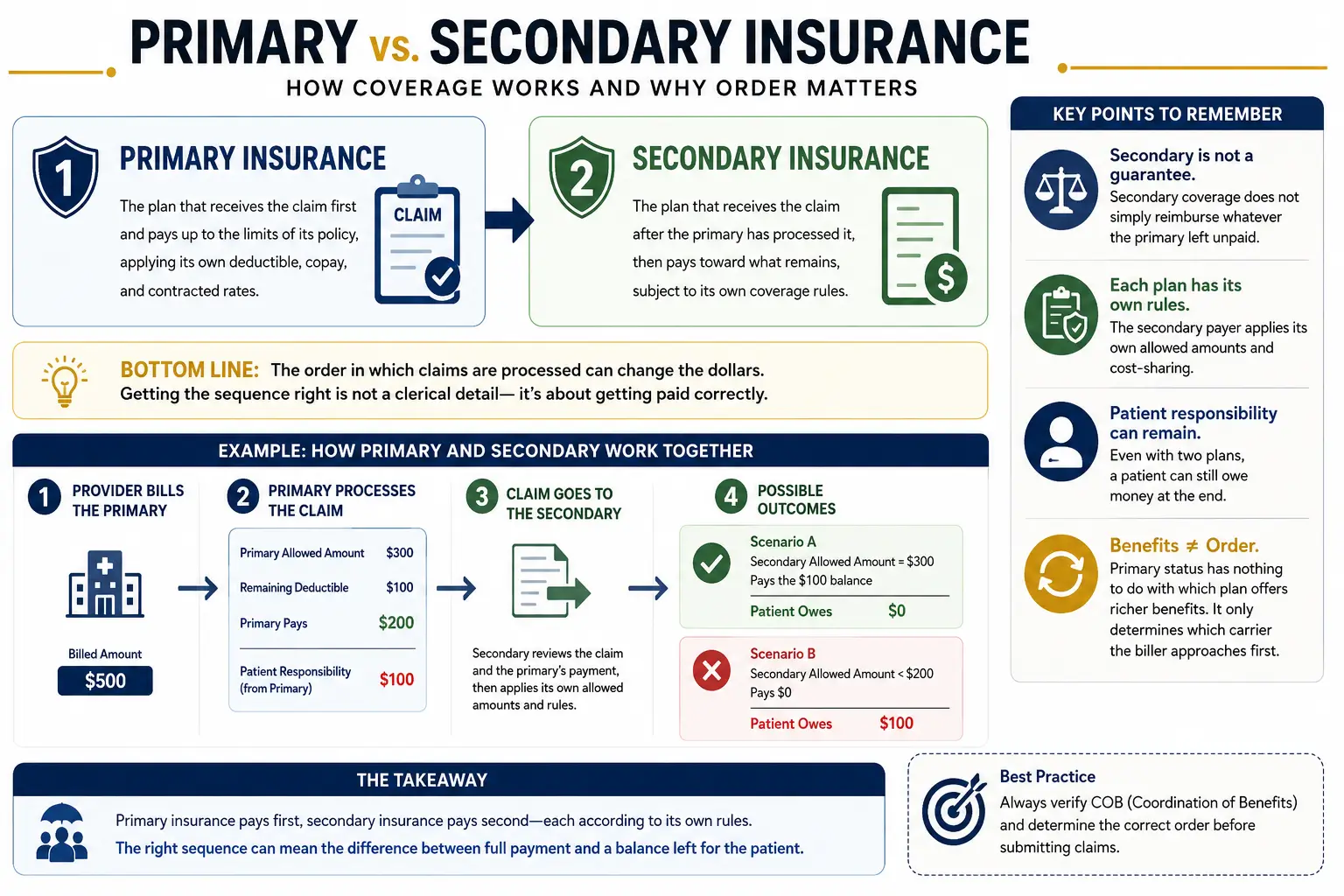
The primary insurance is the plan that receives the claim first and pays up to the limits of its policy, applying its own deductible, copay, and contracted rates. The secondary insurance receives the claim after the primary has processed it, then pays toward what remains, subject to its own coverage rules.
Secondary coverage does not simply reimburse whatever the primary left unpaid. The secondary payer applies its own allowed amounts and cost-sharing, and it often pays the lesser of two figures: what it would have paid as the primary, or the balance left after the primary’s payment. A patient with two plans can still owe money at the end.
Primary status has nothing to do with which plan offers richer benefits. It only marks which carrier the biller approaches first.
A short numeric example shows the mechanics. Say a provider bills a primary plan $500 for a procedure. The primary allows $300 under its contract, applies a $100 remaining deductible, and pays $200. That leaves $100 in patient responsibility on the primary’s remittance. The claim then goes to the secondary. If the secondary’s allowed amount is also $300 and its coordination method is designed to keep the patient whole, it may pay the $100 balance and the patient owes nothing. If the secondary allows less than the primary already paid, it may pay nothing at all. The order changes the dollars, which is why sequence is not a clerical detail.
Coordination of benefits and why payer order matters
Coordination of benefits (COB) is the process insurers use to decide who pays first, second, and, when it applies, third, so that combined payments do not exceed the total charge. The National Association of Insurance Commissioners (NAIC) published its first model COB regulation in 1971 as a template for states and insurers to adopt. Most states built their COB rules on that model, which is why the same logic appears across commercial carriers.
For billing, COB sets a strict sequence. Submit to the primary payer first. Wait for the remittance advice or explanation of benefits (EOB). Then bill the secondary and attach the primary’s payment information, because the secondary cannot finish adjudicating without it. Skip that order and the secondary claim denies for “COB” or “other insurance primary,” and the account starts over.
There is a deadline hidden in that sequence. Many secondary payers run their own timely filing clock, and it starts after the primary adjudicates. Billers who guess at the order, get a denial, and rework the claim can burn through those days and lose the secondary payment entirely. Getting the order right the first time protects both the primary and secondary claims.
How to determine which insurance is primary

When a patient carries more than one plan, a short list of rules settles the order. Insurers apply the first rule that fits and stop there.
The plan that covers you as the subscriber pays first
Known as the non-dependent/dependent rule, this is the starting point for adults with two plans. The plan that covers a person as the employee, member, or subscriber is primary for that person. A plan that covers the same person as a dependent, for example under a spouse, is secondary.
This answers how to determine primary and secondary insurance for a spouse. Suppose both spouses have their own employer coverage, and each also enrolls as a dependent on the other’s plan. Each person’s own plan is primary for them, and the spouse’s plan is secondary. Maria’s employer plan pays first for Maria. Her husband’s plan pays second for Maria. The reverse holds for him.
The birthday rule for a child on both parents’ plans
For a dependent child covered by both parents who live together, insurers use the birthday rule. The parent whose birthday falls earlier in the calendar year, measured by month and day rather than year of birth, holds the primary plan for the child. The other parent’s plan is secondary.
A quick example clears it up. If one parent’s birthday is March 4 and the other’s is September 20, the March parent’s plan pays first for every child on both policies, even if the September parent is older or earns more. When both parents share the same birthday, the plan that has covered the person longer is treated as primary.
The birthday rule is not a federal statute. It is a provision from the NAIC model that most states and insurers have adopted, which is why it governs how to determine primary and secondary insurance for a child in the majority of routine cases.
Divorced or separated parents
Custody changes the analysis. Under the NAIC model order, a court decree that assigns responsibility for the child’s health coverage controls first. If a decree grants joint custody without naming who is responsible, the birthday rule applies. Absent any decree, the order generally runs: the custodial parent’s plan, then the custodial parent’s spouse’s plan, then the non-custodial parent’s plan, then that parent’s spouse’s plan.
State rules vary here, so confirm with the patient and, when needed, the carrier. A biller who assumes the birthday rule for a divorced family can sequence the claim incorrectly and trigger a denial.
Active coverage outranks retiree or COBRA coverage
The active/inactive rule ranks employment status. Coverage tied to a current, active employee pays before coverage a person holds as a retiree or through COBRA continuation. If a patient has an active employer plan and a COBRA plan at the same time, the active plan is primary and COBRA is secondary.
Medicare primary vs. secondary
Medicare coordination follows the Medicare Secondary Payer (MSP) provisions in Section 1862(b) of the Social Security Act, spelled out in the Medicare Secondary Payer Manual (CMS Publication 100-05). Whether Medicare pays first depends on why the person qualifies and, for working-age and disabled beneficiaries, the size of the employer behind the group health plan.
Basis for Medicare | Employer size | Who pays first |
Age 65 or older (working aged) | 20 or more employees | Group health plan primary, Medicare secondary |
Age 65 or older (working aged) | Fewer than 20 employees | Medicare primary |
Disability (under 65) | 100 or more employees | Group health plan primary, Medicare secondary |
Disability (under 65) | Fewer than 100 employees | Medicare primary |
End-stage renal disease | Any size | Group health plan primary for the first 30 months, then Medicare |
A few points billers rely on daily. For a beneficiary who keeps working past 65 at a company with 20 or more employees, the employer plan pays first and Medicare is secondary. Retiree coverage flips that: once employment ends, Medicare generally becomes primary and the retiree plan pays second. For end-stage renal disease, the group health plan stays primary for a 30-month coordination period regardless of employer size, and Medicare becomes primary after that window closes.
Getting the employer-size threshold wrong is one of the most frequent MSP errors. The 20-employee count applies to age-based eligibility. The 100-employee count applies to disability-based eligibility. They are not interchangeable, and a plan that would be primary for a 66-year-old active worker can be secondary for a 40-year-old disabled worker at the same company.
Is Medicaid primary or secondary?
Medicaid is almost always secondary. Federal law makes it the payer of last resort, meaning every other liable source pays before Medicaid contributes anything. Section 1902(a)(25) of the Social Security Act requires states to identify liable third parties and make sure they pay first, a requirement known as third-party liability (TPL).
For a patient with Medicaid and a commercial plan, bill the commercial carrier first, then Medicaid. For a patient with both Medicare and Medicaid (a dual-eligible), Medicare pays first for covered services, and Medicaid may pick up Medicare cost-sharing or cover services Medicare excludes, such as long-term care. Providers are generally expected to bill any known third party before submitting to Medicaid. A claim sent to Medicaid first, while other coverage exists on file, usually comes back denied.
Verifying coverage and billing in the right order
The rules only help when the coverage information is accurate at the point of service. A practical sequence keeps claims clean:
- Collect every insurance card and ask the patient directly whether they have other coverage through a spouse, a parent, an employer, Medicare, or Medicaid.
- Run eligibility verification on each plan before the visit, confirming active status and checking the COB information the payer already has on file.
- Identify the primary using the rules above, and record the reason in the account (subscriber versus dependent, birthday rule, employer size, active versus retiree).
- Bill the primary, post the remittance, then bill the secondary with the primary’s EOB attached.
- When a third plan exists, the tertiary payer is billed last, after both the primary and secondary have finished adjudicating.
When two payers each believe the other is primary, the claim stalls in what billers call a COB loop. The fix usually starts with the patient, who often needs to call the carrier and update the coordination-of-benefits information on record. Payers frequently will not release payment until their internal COB file matches the patient’s actual coverage, so the account cannot be cleared from the billing office alone.
Payer order is not guesswork. The subscriber-versus-dependent rule, the birthday rule, the active-coverage rule, and the Medicare and Medicaid statutes each point to a specific answer, and applying them in order tells you which carrier to bill first. Confirm the coverage, document the reason for the sequence, and bill primary before secondary. Handled that way, determining primary vs. secondary insurance holds up when the claim reaches the payer, and the patient is billed only for what they genuinely owe.