


The 83036 CPT code shows up on more primary care and endocrinology claims than almost any other laboratory code, and it is also one of the more misbilled. The test itself is routine. The rules around it are not. A missing modifier, a frequency edit, or a diagnosis code that does not match Medicare’s covered list can turn a clean $12 claim into a denial that costs far more than that to rework.
Diabetes gives this code its volume. The CDC’s National Diabetes Statistics Report, released in January 2026, found that more than 40 million people in the United States (11.6 percent of the population) had diabetes in 2023, with roughly 11 million of them undiagnosed and another 115 million adults living with prediabetes. Every one of those diagnoses and screenings runs through an HbA1c test at some point, and most of those tests are reported with 83036. This guide walks through what the code covers, when it needs a modifier, how Medicare limits its use, and which diagnoses actually get it paid.
What CPT 83036 covers
The American Medical Association defines CPT code 83036 as “Hemoglobin; glycosylated (A1c).” It sits in the Chemistry Procedures subsection of the Pathology and Laboratory section of the CPT code set.
The test measures glycated hemoglobin, the fraction of hemoglobin that has glucose bound to it. Because red blood cells live about 120 days, the result reflects average blood glucose over roughly the preceding 60 to 90 days rather than a single moment. That two to three month window is what makes the HbA1c useful. A fasting glucose tells you about one morning. An A1c tells you how the past season went.
Clinicians use it in three distinct situations: to help diagnose diabetes, to monitor long-term glycemic control in patients already diagnosed, and to identify prediabetes. The American Diabetes Association’s diagnostic thresholds are the reference point most payers assume in the background. An A1c of 6.5 percent or higher supports a diabetes diagnosis, 5.7 to 6.4 percent falls in the prediabetes range, and below 5.7 percent is considered normal.
One coding rule trips people up early. Report 83036 once per patient per date of service. A patient with type 2 diabetes, diabetic kidney disease, and retinopathy still gets one A1c, not three. The code is not tied to the number of conditions it helps manage.
83036 versus 83037: choosing the right code
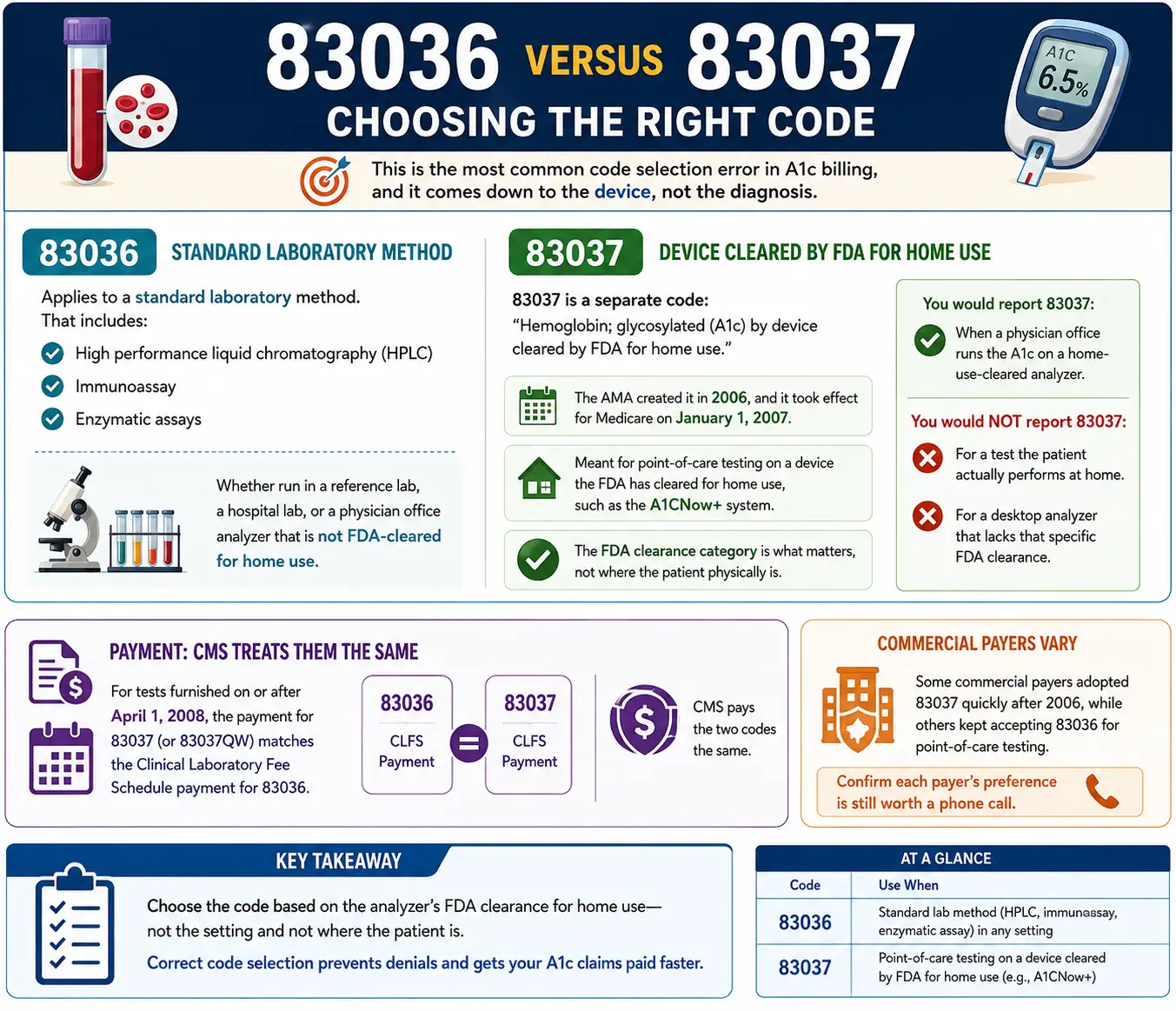
This is the most common code selection error in A1c billing, and it comes down to the device, not the diagnosis.
83036 applies to a standard laboratory method. That includes high performance liquid chromatography (HPLC), immunoassay, and enzymatic assays, whether run in a reference lab, a hospital lab, or a physician office analyzer that is not FDA-cleared for home use.
83037 is a separate code, “Hemoglobin; glycosylated (A1c) by device cleared by FDA for home use.” The AMA created it in 2006, and it took effect for Medicare on January 1, 2007. It is meant for point-of-care testing on a device the FDA has cleared for home use, such as the A1CNow+ system. Note the wording carefully. The FDA clearance category is what matters, not where the patient physically is. You would report 83037 when a physician office runs the A1c on a home-use-cleared analyzer. You would not report it for a test the patient actually performs at home, and you would not use it for a desktop analyzer that lacks that specific FDA clearance.
CMS pays the two codes the same. For tests furnished on or after April 1, 2008, the payment for 83037 (or 83037QW) matches the Clinical Laboratory Fee Schedule payment for 83036. Some commercial payers adopted 83037 quickly after 2006, while others kept accepting 83036 for point-of-care testing, so confirming each payer’s preference is still worth a phone call.
When 83036 needs a modifier
Many 83036 claims carry no modifier at all. A reference lab running an immunoassay on a drawn specimen usually reports the bare code. Modifiers enter the picture in three specific circumstances.
The QW modifier and CLIA-waived testing
The QW modifier signals that a test was performed at a waived complexity level by a laboratory holding a Clinical Laboratory Improvement Amendments (CLIA) Certificate of Waiver. CLIA’88 (Public Law 100-578, codified at 42 U.S.C. 263a) requires that any facility testing human specimens be appropriately certified for the complexity of each test it runs.
Both 83036QW and 83037QW appear on the CMS list of CLIA-waived codes. Here is the distinction that matters. The classic central-lab A1c method behind 83036 is moderate complexity and does not carry QW. When a physician office runs the A1c on an approved CLIA-waived analyzer, Medicare and many payers want the QW modifier appended so the claim edit recognizes the test as legitimately performed at a waived level.
Get this backward in either direction and the claim suffers. Medicare will deny a waived-test claim, place of service 11 (office), when the QW is missing, even if the facility holds a valid certificate. Appending QW to a reference-lab assay that was not actually run on a waived device is equally wrong. Match the modifier to the device and setting, not to habit.
So, does 83036 need a QW modifier? Only when the performing device and location are CLIA-waived. For a moderate or high complexity lab, it does not.
Modifiers 91 and 90
Modifier 91 identifies a clinical diagnostic laboratory test that was repeated on the same day, for the same patient, to obtain subsequent results. It is not for rerunning a botched specimen and not a workaround for ordering more tests. Same-day A1c repeats are unusual given the test’s biology, so payers expect documentation explaining why the repeat was medically necessary.
Modifier 90 applies when an outside reference laboratory performed the analysis and the billing entity is submitting on its behalf.
One correction worth making, because it circulates in coding forums: modifiers 26 (professional component) and TC (technical component) do not apply to 83036. It is a clinical laboratory test paid under the Clinical Laboratory Fee Schedule, and CLFS codes are not split into professional and technical parts the way certain pathology services are. If you see 83036-26 on a claim, someone confused it with a different family of codes.
Medicare coverage under NCD 190.21
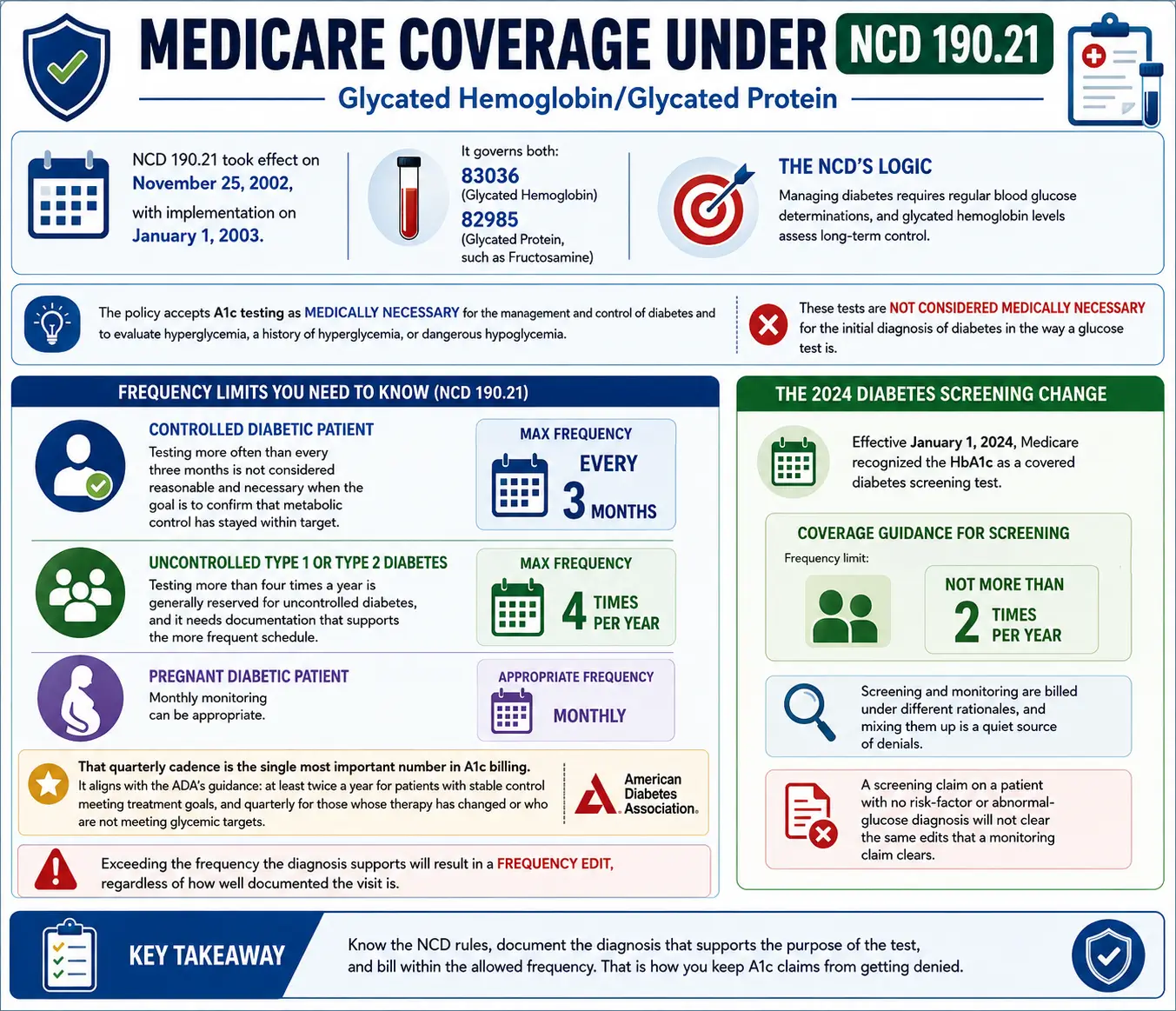
Medicare’s coverage rules for the A1c live in National Coverage Determination 190.21, “Glycated Hemoglobin/Glycated Protein.” The NCD took effect on November 25, 2002, with implementation on January 1, 2003, and it governs both 83036 and 82985 (glycated protein, such as fructosamine).
The NCD’s logic is straightforward. Managing diabetes requires regular blood glucose determinations, and glycated hemoglobin levels assess long-term control. The policy accepts A1c testing as medically necessary for the management and control of diabetes and to evaluate hyperglycemia, a history of hyperglycemia, or dangerous hypoglycemia. It also states plainly that these tests are not considered medically necessary for the initial diagnosis of diabetes in the way a glucose test is, which is a nuance worth remembering when you are choosing the ordering rationale.
Frequency limits you need to know
NCD 190.21 sets the ceilings that drive most frequency denials:
- For a controlled diabetic patient, testing more often than every three months is not considered reasonable and necessary when the goal is to confirm that metabolic control has stayed within target.
- Testing more than four times a year is generally reserved for uncontrolled type 1 or type 2 diabetes, and it needs documentation that supports the more frequent schedule.
- For pregnant diabetic patients, monthly monitoring can be appropriate.
That quarterly cadence is the single most important number in A1c billing. It aligns with the ADA’s own guidance, which recommends testing at least twice a year for patients meeting treatment goals with stable control, and quarterly for patients whose therapy has changed or who are not meeting glycemic targets. When you exceed the frequency the diagnosis supports, the claim hits a frequency edit regardless of how well documented the visit is.
The 2024 diabetes screening change
A newer wrinkle affects patients who do not yet carry a diabetes diagnosis. Effective January 1, 2024, Medicare recognized the HbA1c as a covered diabetes screening test, with the coverage guidance setting a frequency limit of not more than twice per year for screening. Screening and monitoring are billed under different rationales, and mixing them up is a quiet source of denials. A screening claim on a patient with no risk-factor or abnormal-glucose diagnosis will not clear the same edits that a monitoring claim clears.
Covered diagnosis codes for 83036 (ICD-10)
Medicare and commercial payers maintain lists of payable diagnoses for the A1c through the NCD and, at the contractor level, through Local Coverage Determinations and the covered-code articles published by MACs such as Palmetto GBA and Noridian. The ordering provider is solely responsible for assigning the diagnosis, and the code has to reflect the documented reason for the test.
The diagnoses that support 83036 most often are:
- E10.- for type 1 diabetes mellitus, including the specific complication codes such as diabetic chronic kidney disease and diabetic retinopathy subtypes.
- E11.- for type 2 diabetes mellitus and its complications.
- R73.03 for prediabetes, with the broader R73.0- family (impaired fasting glucose, impaired glucose tolerance, other abnormal glucose) covering related screening rationales.
A precision point that saves denials: prediabetes is R73.03 specifically, not R73.09. R73.09 is “other abnormal glucose,” a different clinical statement. Several billing references online list them interchangeably, and payers do not.
Because contractor lists differ and are updated on a quarterly basis, verify the covered ICD-10 codes against the current LCD or covered-code article for your MAC before assuming a diagnosis is payable. A diagnosis that clears in one jurisdiction may sit outside the list in another.
Reimbursement for 83036
The A1c is inexpensive to bill. It is one of the lower-cost codes on the Medicare Clinical Laboratory Fee Schedule, where payment is the lesser of the amount billed, the local fee, or the national limitation amount, with no beneficiary copay or deductible applied to CLFS services.
For calendar year 2018, the national limitation amount for 83036 was $13.32, with a national floor of $8.50, according to the College of American Pathologists’ summary of that year’s rates. Payment has stayed in that general neighborhood since, held down by the payment reductions phased in under the Protecting Access to Medicare Act (PAMA). Under the 2026 CLFS annual update (Change Request 14312, effective January 1, 2026), CMS continued the PAMA framework, and further data-driven rate changes were again delayed by legislation passed in November 2025. Because the exact national amount shifts slightly year to year and by geography, confirm the current figure on the CLFS file for your locality rather than relying on a fixed number.
The practical takeaway is that the margin on a single A1c is thin, which is exactly why denials hurt. The cost of reworking a rejected claim can exceed the payment itself. Novitas, one of the Medicare contractors, has reported receiving roughly 1.7 million clerical-error reopening requests a year from Part B providers correcting claims that could have been submitted correctly the first time. A meaningful share of those involve missing or misapplied modifiers.
Common denial reasons and how documentation prevents them
Most 83036 denials fall into a short list of causes, and each has a clean fix:
- Frequency edit. Too many tests in the covered period. Match ordering frequency to the patient’s diagnosis, and document uncontrolled status when you exceed quarterly testing.
- Missing QW. A waived in-office test billed without the modifier. Append QW when, and only when, the device and setting are waived.
- Unsupported diagnosis. An ICD-10 code that is not on the payer’s covered list, or a vague code where a specific one exists. Use R73.03 for prediabetes, and code diabetes complications to the level the record supports.
- Wrong code for the device. 83036 billed for a home-use-cleared point-of-care device that should have been 83037.
Documentation is the through-line. The medical record needs to show why the test was ordered, what the patient’s diabetic status is, and, when testing runs more often than the NCD’s default, what clinical circumstance justifies it. A1c results can also be unreliable in patients with hemoglobin variants, high fetal hemoglobin (levels above 10 percent can lower measured values), anemia, recent transfusion, or any condition that alters red cell turnover. In those cases, as the ADA notes, an alternative such as glycated protein (fructosamine, code 82985) may be indicated, and NCD 190.21 anticipates that both may occasionally appear on the same day for a single initial assessment.
To summarize the 83036 CPT code in the terms that keep claims clean: it reports the standard laboratory HbA1c, it is billed once per date of service, it carries QW only for CLIA-waived in-office testing, it is covered under NCD 190.21 at a default of once every three months for controlled diabetes with room for more frequent testing when documentation supports it, and it is paid at a low CLFS rate that makes first-pass accuracy the whole game. Distinguish it cleanly from 83037, tie it to a payable diabetes or abnormal-glucose diagnosis, and respect the frequency ceiling, and the code behaves. Ignore any one of those, and a routine test becomes a reworked claim.
