


A single tube of blood, drawn once and processed for four values, generates more billing questions than almost any other routine laboratory order. The lipid panel CPT code, 80061, looks simple enough on a superbill. In practice, it sits at the intersection of three separate rulebooks: what the American Medical Association’s code definition actually requires, what Medicare will pay for and under what conditions, and what a given commercial plan treats as preventive. Getting any one of those three wrong is how a clean-looking claim ends up denied, or how a patient gets billed for a test that should have cost nothing.
This piece works through the mechanics: what CPT 80061 bundles, how it pairs with ICD-10 codes, where Medicare’s actual rules differ from what a lot of billing guides repeat, and what changed in 2026 that touches how these results get used clinically, even though it does not touch the code itself.
What CPT code 80061 actually covers
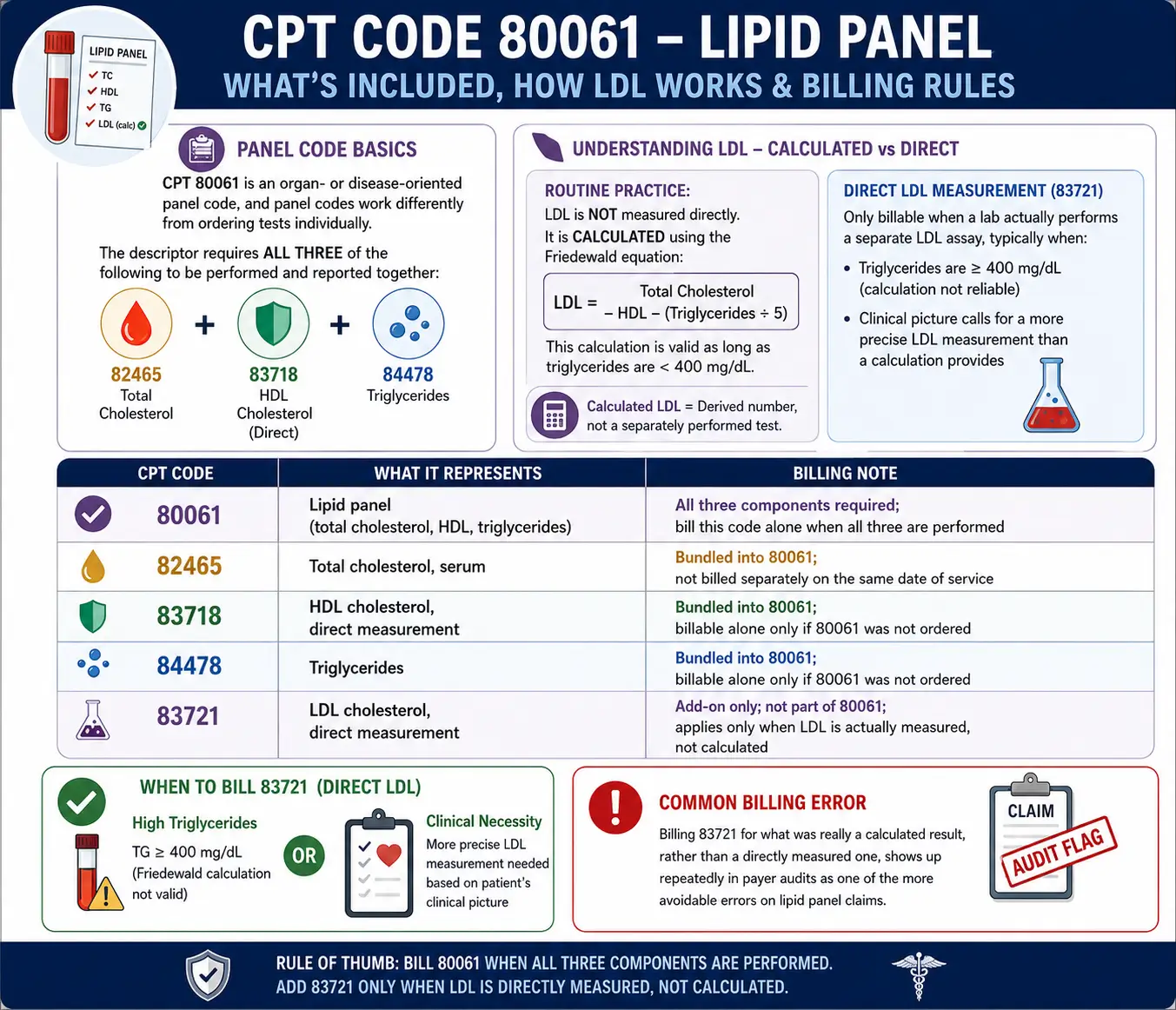
CPT 80061 is an organ- or disease-oriented panel code, and panel codes work differently from ordering tests individually. The descriptor requires all three of the following to be performed and reported together: total cholesterol (82465), direct HDL cholesterol (83718), and triglycerides (84478).
LDL is where confusion tends to start. In routine practice, LDL is not measured directly. It is calculated from the other three values using the Friedewald equation (LDL equals total cholesterol minus HDL minus triglycerides divided by five), which holds up reasonably well as long as triglycerides stay under 400 mg/dL. A calculated LDL is a derived number, not a separately performed test, so it has no billing code of its own. Direct LDL measurement (83721) only becomes billable when a lab actually runs that separate assay, typically because triglycerides are too high for the Friedewald math to hold, or because the clinical picture calls for a more precise LDL measurement than a calculation provides.
CPT code | What it represents | Billing note |
80061 | Lipid panel (total cholesterol, HDL, triglycerides) | All three components required; bill this code alone when all three are performed |
82465 | Total cholesterol, serum | Bundled into 80061; not billed separately on the same date of service |
83718 | HDL cholesterol, direct measurement | Bundled into 80061; billable alone only if 80061 was not ordered |
84478 | Triglycerides | Bundled into 80061; billable alone only if 80061 was not ordered |
83721 | LDL cholesterol, direct measurement | Add-on only; not part of 80061; applies only when LDL is actually measured, not calculated |
Billing 83721 for what was really a calculated result, rather than a directly measured one, shows up repeatedly in payer audits as one of the more avoidable errors on lipid panel claims.
ICD-10 codes and medical necessity
Medical necessity for 80061 rides on the diagnosis code attached to the order, and the two common use cases point in different directions.
A screening panel, ordered for an asymptomatic patient with no personal history of lipid disorders, pairs with Z13.220 (encounter for screening for lipoid disorders). A diagnostic panel, ordered because a patient has a known or suspected lipid disorder or a condition that requires lipid monitoring, needs a code that actually describes that condition.
ICD-10 code | Description | Typical use |
Z13.220 | Encounter for screening for lipoid disorders | Asymptomatic screening, no prior diagnosis |
E78.5 | Hyperlipidemia, unspecified | Used by default more often than its specificity supports |
E78.00 | Pure hypercholesterolemia, unspecified | Elevated total cholesterol or LDL as the primary concern |
E78.1 | Pure hyperglyceridemia | Elevated triglycerides as the primary concern |
E78.2 | Mixed hyperlipidemia | Both cholesterol and triglycerides elevated |
E11.65 | Type 2 diabetes with hyperglycemia | Lipid monitoring in support of diabetes management |
E78.5 gets reached for by default more often than it should. Payers rarely reject it outright, but a more specific code, when the chart actually supports one, holds up better under a medical necessity review, and it signals that the ordering provider looked at the result pattern instead of defaulting to the least specific option on the list.
How Medicare actually covers this test
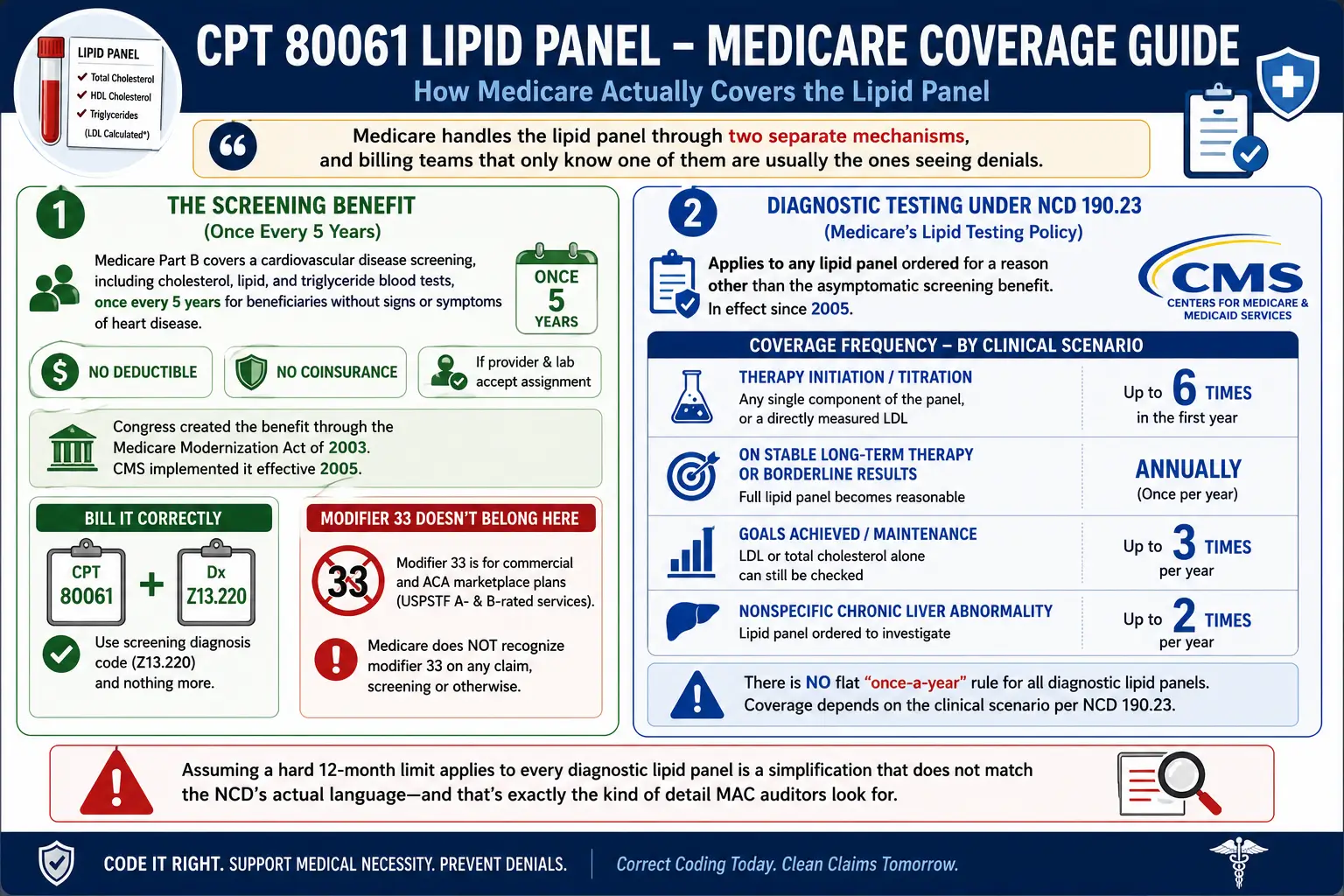
Medicare handles the lipid panel through two separate mechanisms, and billing teams that only know one of them are usually the ones seeing denials.
The screening benefit, and why modifier 33 doesn’t belong here
Medicare Part B covers a cardiovascular disease screening, including cholesterol, lipid, and triglyceride blood tests, once every five years for beneficiaries without signs or symptoms of heart disease, at no deductible and no coinsurance, as long as the ordering provider and lab accept assignment. CMS states this directly on its own coverage page. Congress created the benefit through the Medicare Modernization Act of 2003, and CMS implemented it effective 2005, according to its own coverage database.
Billing it correctly means pairing 80061 with a screening diagnosis code, typically Z13.220, and nothing more. Modifier 33 is not part of that mechanism. The modifier exists for commercial and ACA marketplace plans responding to the Affordable Care Act’s requirement that USPSTF A- and B-rated services carry no cost-sharing. Medicare does not recognize modifier 33 on any claim, screening or otherwise. That distinction matters, because billing guidance that instructs practices to append modifier 33 to a Medicare lipid panel claim is describing a rule that belongs to a different payer type entirely.
Diagnostic testing under NCD 190.23
Diagnostic lipid testing, meaning any lipid panel ordered for a reason other than the asymptomatic screening benefit above, falls under National Coverage Determination 190.23, Medicare’s lipid testing policy, in effect since 2005. It does not set a flat once-a-year rule, even though that simplification circulates widely. The actual policy language varies by clinical scenario: any single component of the panel, or a directly measured LDL, may be reasonable up to six times during the first year of therapy titration; a full panel becomes reasonable annually once a patient is on stable long-term therapy or being monitored for borderline results; and after treatment goals are met, LDL or total cholesterol alone can still be checked up to three times a year. Separately, a lipid panel ordered to investigate a nonspecific chronic liver abnormality is capped at twice a year under the same policy.
Practices that assume a hard 12-month limit applies to every diagnostic lipid panel are working from a simplification that does not match the NCD’s actual language, and that gap is exactly the kind of detail a Medicare Administrative Contractor audit tends to catch.
What the 2026 dyslipidemia guideline changes
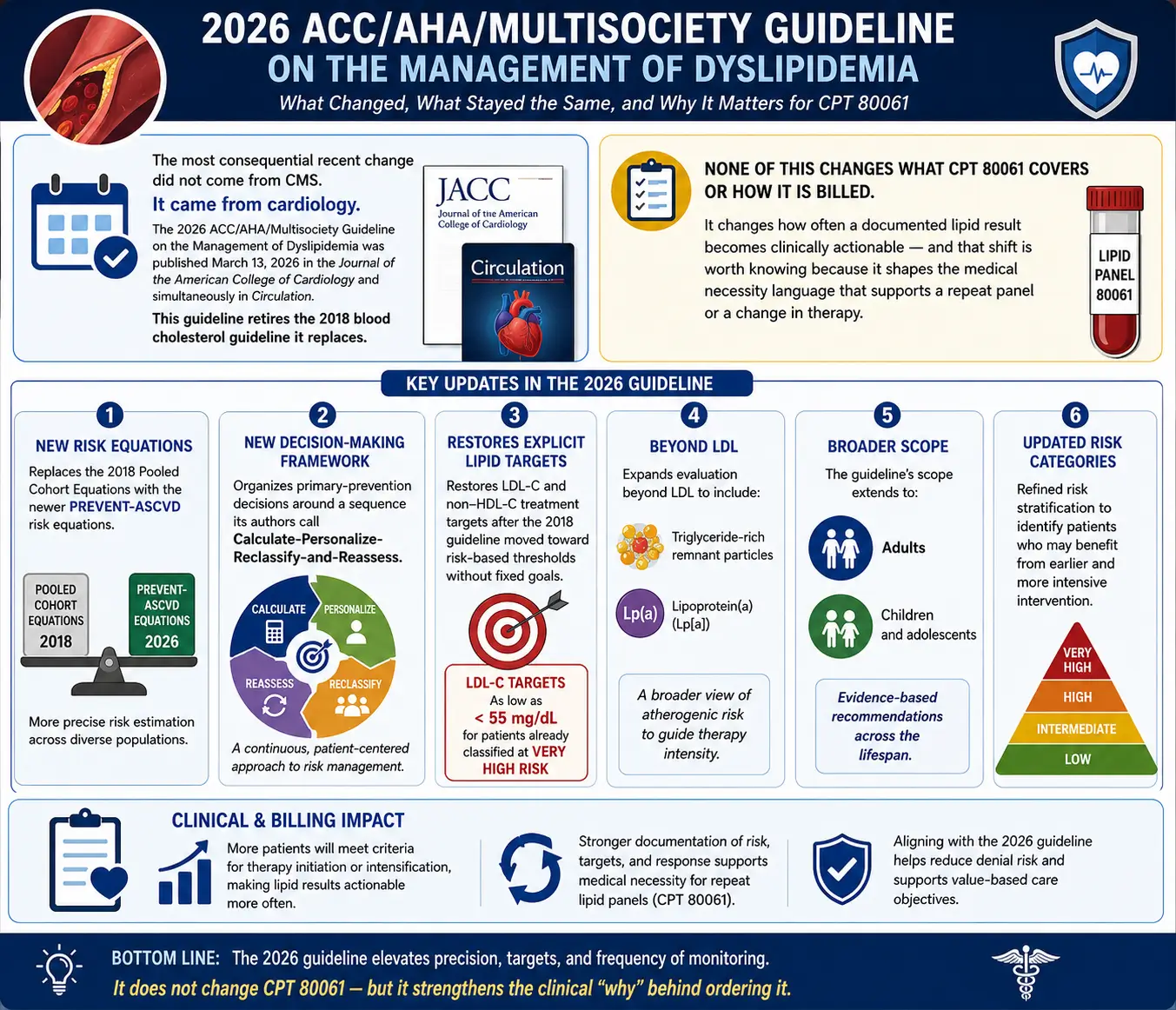
The most consequential recent change did not come from CMS. It came from cardiology. The 2026 ACC/AHA/Multisociety Guideline on the Management of Dyslipidemia, published March 13 in the Journal of the American College of Cardiology and simultaneously in Circulation, retired the 2018 blood cholesterol guideline it replaces.
The new guideline swaps the older Pooled Cohort Equations for the newer PREVENT-ASCVD risk equations, organizes primary-prevention decisions around a sequence its authors call Calculate-Personalize-Reclassify-and-Reassess, and restores explicit LDL-C and non-HDL-C treatment targets (as low as under 55 mg/dL for patients already classified at very high risk) after the 2018 version moved toward risk-based thresholds without fixed numeric goals. It also widens the evaluation beyond LDL to triglyceride-rich remnant particles and lipoprotein(a), and its scope extends to children as well as adults.
None of this changes what CPT 80061 covers or how it is billed. It changes how often a documented lipid result becomes clinically actionable, and that shift is worth knowing because it shapes the medical necessity language that supports a repeat panel or a change in therapy.
Where adult screening guidance stands today
Adult screening guidance has a detail that a lot of billing references get wrong. The USPSTF’s own dedicated recommendation on screening for lipid disorders, last updated in 2008 (A grade for men 35 and older and at-risk women 45 and older, B grade for younger adults with risk factors), is archived on the Task Force’s own site. It was not replaced by a new standalone lipid-screening statement.
Instead, cholesterol testing now sits inside the USPSTF’s 2022 update on statin use for primary prevention of cardiovascular disease, published in JAMA. That recommendation calls for offering a statin to adults 40 to 75 with at least one cardiovascular risk factor, such as dyslipidemia, diabetes, hypertension, or smoking, and a calculated 10-year ASCVD risk of 10 percent or higher (grade B), and for selectively offering one in the 7.5-to-10-percent range (grade C). For adults 76 and older, the Task Force states the evidence is insufficient either way.
None of those grades attach to the lipid panel directly. They attach to the statin decision, and that decision cannot be made without the cholesterol values the panel provides. Documentation that frames an adult screening panel as supporting a cardiovascular risk assessment, rather than as a bare routine test, ties the order to an active recommendation instead of a retired one.
Fasting versus non-fasting: what actually changed
Ordering staff have treated an overnight fast as non-negotiable before a lipid draw for a long time. That requirement has loosened considerably. A 2016 joint consensus statement from the European Atherosclerosis Society and the European Federation of Clinical Chemistry and Laboratory Medicine, published in the European Heart Journal, concluded that non-fasting samples should become the routine approach for lipid profiles, with fasting reserved for specific circumstances: triglycerides already known to run above 400 mg/dL, recovery from pancreatitis linked to triglycerides, starting a medication likely to raise triglycerides sharply, a known genetic lipid disorder, or a blood draw that also needs a fasting glucose.
The National Lipid Association’s 2015 patient-centered management report reached a similar position, recommending that adults 20 and older get a fasting or non-fasting lipid profile at least every five years, with total cholesterol and HDL-C as the minimum components measured.
For billing purposes, CPT 80061 does not change based on fasting status, and no modifier distinguishes a fasting draw from a non-fasting one. The fasting instruction belongs in the clinical order and the chart note, not on the claim line; a payer questioning medical necessity looks for that detail in the documentation.
Pediatric and adolescent screening: the age question
Age is a detail most billing guides skip. The National Heart, Lung, and Blood Institute’s 2011 Integrated Guidelines, published in Pediatrics and endorsed by the American Academy of Pediatrics, call for universal lipid screening once between ages 9 and 11, and again between 17 and 21, regardless of family history. Selective screening starts earlier, from age 2, for children with a family history of premature atherosclerotic disease or familial hypercholesterolemia.
The universal pediatric screen can be run non-fasting, using non-HDL cholesterol (total cholesterol minus HDL-C) in place of a calculated LDL, since non-HDL-C predicts risk about as well in this age group without depending on the Friedewald assumptions. A pediatric practice billing 80061 at a 10-year-old’s well visit is not doing anything preventive-only for its own sake; it is following a specific, dated recommendation, and that recommendation is what belongs in the note if a payer questions why an asymptomatic child was tested.
Common billing errors to check before submission
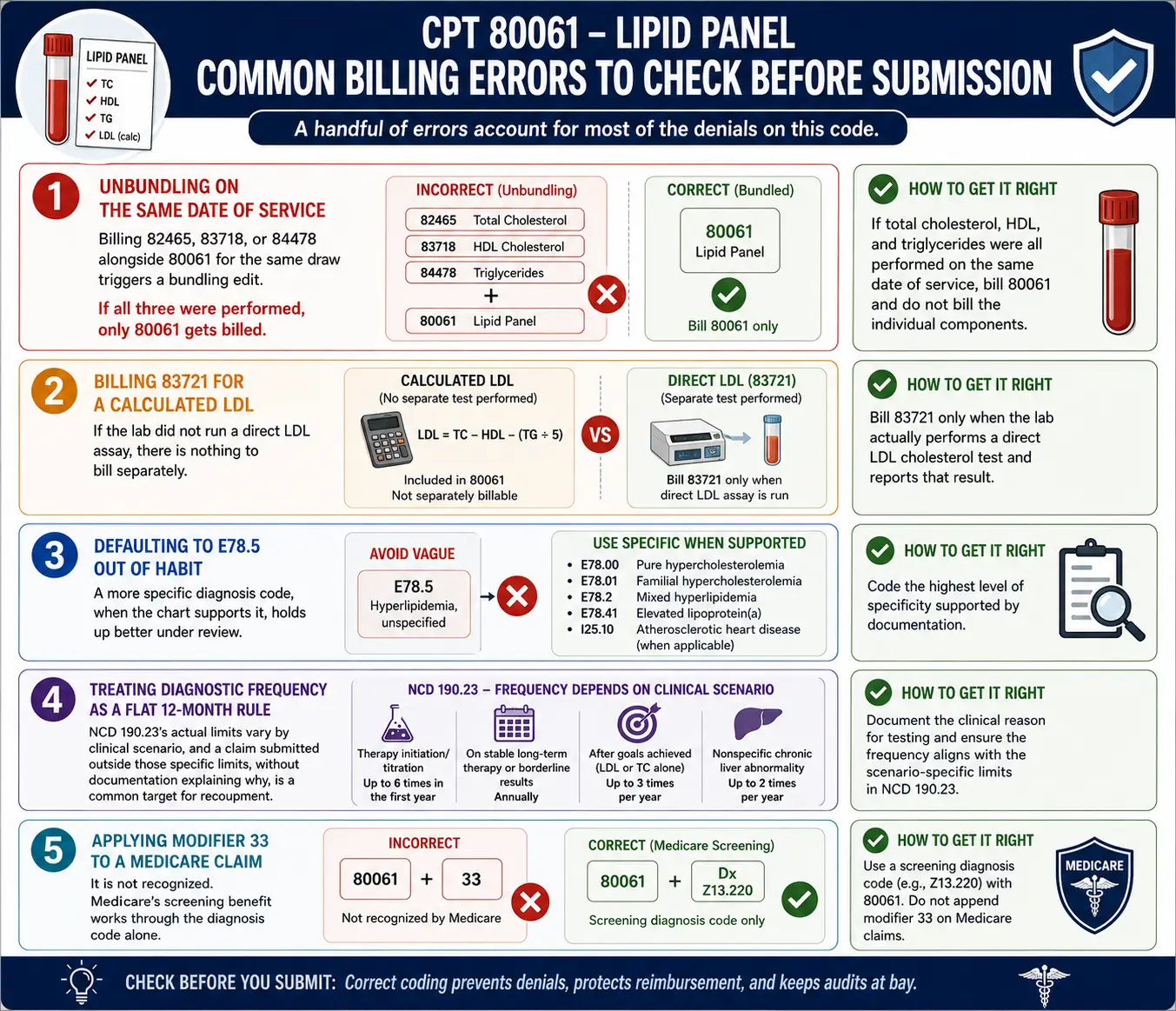
A handful of errors account for most of the denials on this code:
- Unbundling on the same date of service. Billing 82465, 83718, or 84478 alongside 80061 for the same draw triggers a bundling edit. If all three were performed, only 80061 gets billed.
- Billing 83721 for a calculated LDL. If the lab did not run a direct LDL assay, there is nothing to bill separately.
- Defaulting to E78.5 out of habit. A more specific diagnosis code, when the chart supports it, holds up better under review.
- Treating diagnostic frequency as a flat 12-month rule. NCD 190.23’s actual limits vary by clinical scenario, and a claim submitted outside those specific limits, without documentation explaining why, is a common target for recoupment.
- Applying modifier 33 to a Medicare claim. It is not recognized. Medicare’s screening benefit works through the diagnosis code alone.
Matching the rule to the payer
The lipid panel CPT code looks like one of the simpler entries on a lab fee schedule, and clinically, the test itself is straightforward. The billing side carries more moving parts than that simplicity suggests: an AMA panel definition, a Medicare screening benefit with its own five-year cycle, a separate Medicare diagnostic policy with scenario-specific frequency limits, a modifier that only works for half of these payers, an age-based pediatric recommendation that rarely makes it into general billing guides, and a 2026 guideline change that shifts what counts as clinically indicated without touching the code itself.
Getting 80061 right, consistently, comes down to matching the diagnosis code to the actual reason for the test, documenting that reason specifically enough to survive a second look, and knowing which rule belongs to which payer instead of applying one payer’s logic to another’s claim.