TL;DR: CPT Code 99417 At a Glance
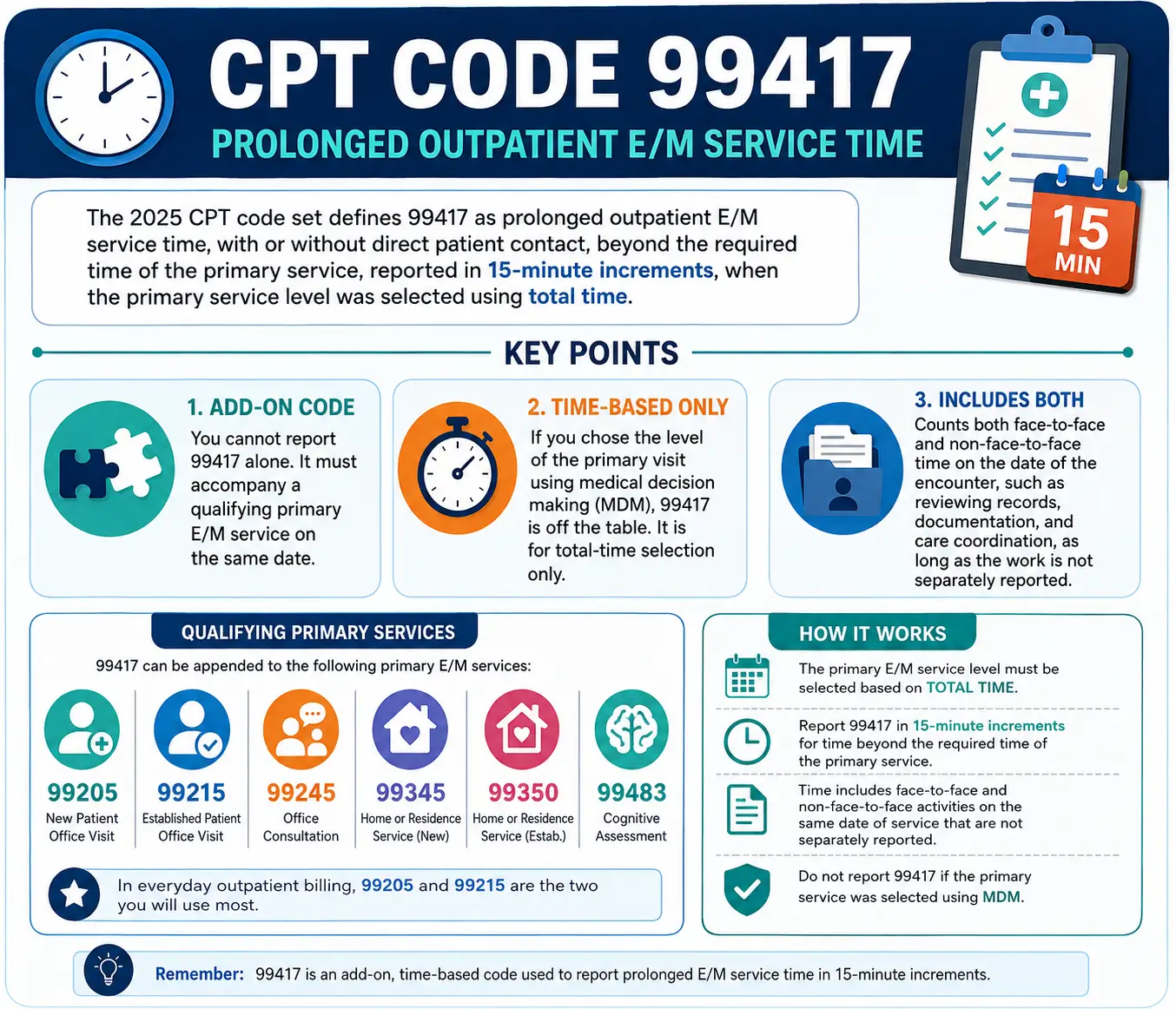
CPT code 99417 is an add-on code for reporting prolonged outpatient evaluation and management services beyond the standard time threshold for office, home, or other outpatient encounters. Here’s what providers and billers need to know:
- What it covers: Additional time spent with or on patient care beyond the typical visit duration
- When to use: After exceeding the primary E/M code’s time threshold by at least 15 minutes
- Commercial payers: Use CPT 99417 after minimum time is exceeded
- Medicare: Use HCPCS code G2212 instead (different time thresholds)
- Time requirement: 15-minute increments beyond the base service time
- Key challenge: Payer-specific policies differ; always verify before billing
- Documentation critical: Must document exact time spent and medical necessity
A comprehensive, authoritative guide for healthcare providers, clinic owners, and medical billing professionals navigating prolonged office visit coding, Medicare vs. commercial payer differences, reimbursement strategies, and emerging revenue cycle trends in 2025–2026.
Introduction: Why CPT Code 99417 Matters Now More Than Ever
Medical billing has never been more complex. With healthcare reimbursement tightening, payer audits intensifying, and compliance demands escalating, even small coding errors can cost practices thousands in lost or delayed revenue. And when it comes to extended patient visits—the ones that demand more time, careful coordination, and detailed documentation—many providers miss billing opportunities altogether.
That’s where CPT code 99417 comes in. This often-overlooked add-on code is designed to reimburse physicians and qualified healthcare professionals for the additional time they spend beyond standard evaluation and management (E/M) visits. Yet the rules governing its use are fragmented, payer-specific, and frequently misunderstood.
Whether you’re billing complex chronic cases, conducting care coordination for multi-comorbid patients, or providing extended counseling sessions, incorrect use of prolonged service codes can trigger denials, audits, or worse—underbilling that leaves money on the table.
This guide deconstructs CPT code 99417, addresses the critical Medicare vs. commercial payer split, and equips you with actionable strategies to maximize compliant reimbursement in 2025.
What Is CPT Code 99417? Official Definition & Scope
The Official Description
According to the 2025 CPT Manual and AMA guidance, CPT code 99417 is defined as:
“Prolonged outpatient evaluation and management service(s) time with or without direct patient contact beyond the required time of the primary service when the primary service level has been selected using total time, each 15 minutes of total time.”
*(List separately in addition to CPT codes 99205, 99215, 99245, 99483, and applicable home/residence E/M codes)*
Key Technical Points
- Add-on code only: CPT 99417 cannot be billed independently; it must accompany a primary E/M service
- Time-based billing: Applicable only when the primary E/M code is selected using total time as the documentation metric
- Incremental billing: Each unit represents 15 minutes of additional time beyond the base service threshold
- Direct or non-face-to-face: Time includes both face-to-face and behind-the-scenes work (EHR documentation, care coordination, review of test results)
- Same calendar day: The prolonged time must occur on the same date as the primary service
- Medical necessity required: Time must be clinically justified and documented in the medical record
CPT 99417 Time Requirements: Understanding the Thresholds
For Commercial Payers (CPT 99417)
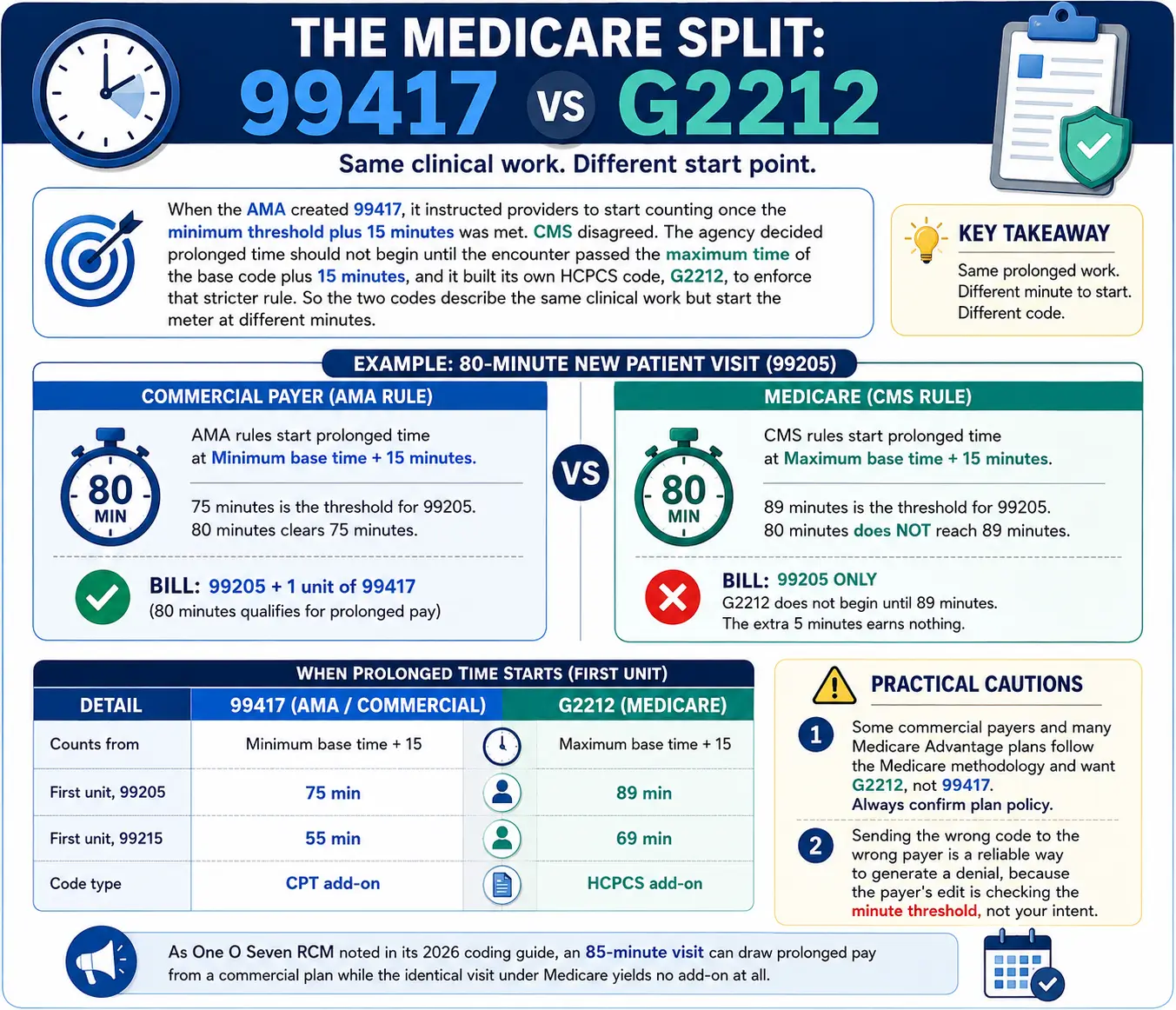
Commercial insurers follow AMA CPT guidelines, which allow CPT 99417 billing once the minimum time for the highest-level primary E/M code is exceeded by 15 minutes.
| Primary Service Code | Service Type | Typical Base Time | 99417 Starts At | Example Scenario |
|---|---|---|---|---|
| 99215 | Established Patient Office Visit (Level 5) | 40 min | 55 min | Patient with uncontrolled diabetes, multiple complications → 65 min visit = 1 unit of 99417 |
| 99205 | New Patient Office Visit (Level 5) | 60 min | 75 min | Complex new patient with 5+ chronic conditions → 90 min visit = 1 unit of 99417 |
| 99245 | Office Consultation (Level 5) | 40 min | 55 min | Specialist review and complex recommendation → 70 min = 1 unit of 99417 |
| 99345 | Home Visit – New Patient (Level 5) | 60 min | 75 min | Homebound patient assessment and care plan → 80 min = 1 unit of 99417 |
| 99350 | Home Visit – Established Patient (Level 5) | 40 min | 55 min | Extended home-based counseling and coordination → 70 min = 1 unit of 99417 |
| 99483 | Cognitive Assessment & Plan (no set time) | Typical: 60 min | 75 min | Comprehensive cognitive evaluation + care plan → 80 min = 1 unit of 99417 |
For Medicare (HCPCS Code G2212 – NOT CPT 99417)
Medicare does not recognize CPT 99417 for office/outpatient prolonged services. Instead, CMS created HCPCS code G2212, which follows different rules:
G2212 Threshold Rule: Billed only after the maximum time for the highest-level primary E/M code is exceeded by at least 15 minutes.
| Primary Code | Time Range | Maximum Time | G2212 Starts At | Impact on Billing |
|---|---|---|---|---|
| 99215 (Est. Patient) | 40–54 min | 54 min | 69 min+ | Medicare requires 15 min additional vs. commercial’s 15 min above minimum (40 min) |
| 99205 (New Patient) | 60–74 min | 74 min | 89 min+ | Medicare requires higher threshold; fewer encounters qualify |
CPT 99417 vs. G2212: The Medicare & Commercial Payer Split
Why the Difference?
In 2021, when the AMA updated E/M guidelines to emphasize time-based billing, CMS and the AMA disagreed on how to handle prolonged services. The AMA wanted to bill prolonged time after the minimum threshold; CMS believed this constituted “double-dipping” given the 18% increase in RVUs already factored into the updated codes. Result: CMS created G2212 as its own workaround.
| Aspect | CPT 99417 (Commercial) | G2212 (Medicare) |
|---|---|---|
| Used by | Most commercial insurers, Medicaid, some MA plans | Medicare, Medicare Advantage (varies), some commercial transitioning |
| Time threshold | Minimum time + 15 min (e.g., 40 + 15 = 55 min for 99215) | Maximum time + 15 min (e.g., 54 + 15 = 69 min for 99215) |
| Reimbursement status | Covered & separately reimbursed by most payers | Covered & separately reimbursed by Medicare; some MA plans pay differently |
| Documentation burden | Document exact time spent; medical necessity recommended | Stricter: CMS audits time logs heavily; full support required |
| Denial risk | Lower if time thresholds properly met | Higher if time not documented accurately; audit-prone |
| First-pass acceptance | Higher (75–85%) when coded correctly | Variable (70–80%) depending on MAC and documentation |
Recent Updates: Is This Changing?
As of December 2025, some indicators suggest a slow shift:
- Some Medicare Advantage (MA) plans have begun accepting CPT 99417 (not just G2212)
- A handful of commercial payers now accept both codes; a few have adopted G2212 exclusively
- CMS has not reversed its position on the G2212/99417 distinction for traditional Medicare
- Always verify with your specific payer before submitting claims
Documentation Requirements for CPT 99417: What You Must Include
The Foundation: Time Documentation
Billing prolonged services without meticulous time documentation is a recipe for audits and denials. Here’s what must appear in the medical record:
- Total visit time: Clearly state the exact start and end time, or cumulative time (e.g., “Total visit time: 70 minutes”)
- Time breakdown (recommended): If possible, note face-to-face vs. non-face-to-face components (e.g., “25 min face-to-face; 20 min EHR work; 25 min care coordination”)
- Clock time or narrative: Either document in/out times explicitly, or use a time summary statement
- Date of service: All time must be on the same calendar date as the primary E/M service
Medical Necessity: The “Why” Behind Extended Time
Simply spending 70 minutes with a patient is insufficient. You must document why the extra time was medically necessary:
Example Documentation:
“Patient presents with uncontrolled type 2 diabetes, hypertension, and recent MI. Due to complexity and patient confusion regarding medication adherence, extended time was spent reviewing current regimen (15 min), discussing cardiovascular and renal risk factors (15 min), adjusting medications (10 min), and providing written education materials with patient teach-back (10 min). Total time: 70 minutes (15 min beyond typical 99215 time).”
Activities That Count Toward Prolonged Time
The CPT manual clarifies that the following activities contribute to billable prolonged service time:
- Reviewing lab, imaging, or other diagnostic test results
- Obtaining a detailed patient history or updating complex medical history
- Performing a comprehensive physical examination
- Discussing treatment options, risks/benefits, and alternatives with the patient
- Counseling on medications, lifestyle, disease management, and prognosis
- Coordinating care with other providers (via phone, email, or EHR messaging)
- Updating the electronic health record with detailed clinical notes
- Developing or revising a comprehensive care plan
- Addressing advance care planning, goals of care, or psychosocial factors
Activities That Do NOT Count
Be careful not to inflate time logs with these non-billable activities:
- Administrative or scheduling tasks unrelated to patient care
- Time spent with clinical staff (nurses, medical assistants) unless the provider is directly supervising and involved
- Waiting time or idle time between patients
- Personal time or breaks
- Time spent on other patients’ care
Common Billing Scenarios: When & How to Bill 99417
Scenario 1: Established Patient with Multiple Chronic Conditions
Clinical Situation: A 72-year-old established patient with diabetes, hypertension, heart failure, and COPD presents for follow-up. Provider spends 65 minutes reviewing test results, adjusting medications, and coordinating with cardiology.
Coding:
- Primary: CPT 99215 (40 min base time)
- Prolonged: CPT 99417 × 1 unit (65 min total = 40 + 25 min additional; qualifies 1 unit of 15 min)
Payer Submission:
- Commercial: Bill both codes as described above
- Medicare: Use G2212 × 1 (requires 69 min minimum for 99215; 65 min falls short—do not bill G2212; bill 99215 only)
Scenario 2: New Patient Complex Presentation
Clinical Situation: A new patient with newly diagnosed stage 3 kidney disease, uncontrolled diabetes, and depression presents for comprehensive intake. Provider conducts detailed history, exam, lab review, and establishes management plan over 85 minutes.
Coding:
- Primary: CPT 99205 (60 min base time)
- Prolonged: CPT 99417 × 1 unit (85 min total = 60 + 25 min additional; qualifies 1 unit)
Payer Submission:
- Commercial: Bill 99205 + 99417
- Medicare: Use G2212 × 1 (requires 75 min minimum for 99205; 85 min qualifies—bill 99205 + G2212)
Scenario 3: Home-Based Cognitive Assessment
Clinical Situation: A physician conducts a comprehensive cognitive assessment and develops a care plan for a patient with mild cognitive impairment during a home visit. Total time: 80 minutes.
Coding:
- Primary: CPT 99483 (Cognitive Assessment & Care Plan; no mandatory time threshold)
- Prolonged: CPT 99417 × 1 (typical time for 99483 ≈ 60 min; 80 min = 60 + 20 min; qualifies 1 unit)
Payer Submission:
- Commercial & Medicare: Bill both 99483 + 99417 (Medicare changed rules in 2025 to accept 99417 with 99483)
2025–2026 Medical Billing & Revenue Cycle Trends Affecting CPT 99417
Trend 1: AI-Driven Automation in Claims Processing
Machine learning and natural language processing (NLP) are revolutionizing coding accuracy. AI systems now:
- Flag prolonged service opportunities in clinical notes in real-time
- Detect time documentation discrepancies before claim submission
- Suggest appropriate modifiers and companion codes automatically
- Identify denial patterns and predict resubmission success rates
Impact on 99417 Billing: AI-powered medical coding platforms achieve 90%+ accuracy in code assignment, helping practices identify missed 99417 opportunities that would otherwise result in underbilling. A2Z Billings’ AI-integrated billing services ensure that prolonged visit opportunities are never overlooked.
Trend 2: Denial Management & Rejection Prevention
Denial rates remain stubbornly high. According to 2024–2025 data:
- 1 in 5 claims (20%) are denied on first submission
- 35% of denials are never appealed (lost revenue)
- Top denial reasons: medical necessity (35%), coding errors (28%), missing authorization (22%)
- Specialty billing sees 15–20% higher denial rates than primary care
For 99417 Specifically: Common denial reasons include:
- Insufficient time documentation (“Cannot verify 70 minutes as claimed”)
- Missing medical necessity statement
- Incorrect time threshold applied for that payer
- Bundling rules violated (e.g., attempting to bill 99417 with incompatible codes)
Solution: A2Z Billings’ denial management expertise ensures proper documentation support, accurate payer-specific coding, and proactive appeals of correctly coded claims.
Trend 3: Prior Authorization Expansion & Digital PA Rules
While CPT 99417 typically doesn’t require prior authorization, many payers are expanding pre-approval requirements for high-complexity E/M services. By 2026, CMS plans to implement digital prior authorization (dPA) systems that will streamline but also complicate workflows.
Action Item: Practices should integrate real-time eligibility and authorization checking into their RCM workflows to prevent claim holds and denials.
Trend 4: EHR Interoperability & FHIR Standards
The healthcare industry is shifting toward HL7 FHIR (Fast Healthcare Interoperability Resources), which enables seamless data exchange between EHRs, billing systems, and payer networks. This means:
- Time-tracking data will flow automatically from EHR to billing system
- Real-time claim submission and status updates become standard
- Documentation gaps are caught before claim generation
- Payer edits are applied instantly, reducing rework
For your 99417 billing: Ensure your EHR’s time-tracking fields are properly mapped to your billing system. Misconfigured interfaces are a leading cause of underbilling and denials.
Trend 5: Credentialing & Revalidation Complexity
Provider credentialing errors now account for a portion of denials. In 2025:
- CAQH ProView re-attestation is required every 90–120 days (not annually)
- Multi-state credentialing has become more complex and time-consuming
- Payers are conducting ongoing verification monthly or quarterly, not just at renewal
- A single expired credential can trigger network deactivation and claim denials
Best Practice: Start credentialing renewal processes 90+ days before expiration. A2Z Billings‘ credentialing services ensure uninterrupted network status and prevent billing disruptions.
Trend 6: Value-Based Care & RCM Alignment
As healthcare shifts from fee-for-service to value-based payment models, RCM strategies are evolving. Practices must now track not just claims submitted, but also:
- Quality metrics tied to reimbursement
- Patient outcomes and satisfaction scores
- Cost per episode of care
- Compliance with clinical guidelines
Implication for 99417: Proper documentation of time, medical necessity, and clinical complexity becomes even more critical for demonstrating value in value-based care models.
—Specialty-Specific Billing Challenges & 99417 Application
Oncology & Hematology
Oncology practices frequently bill prolonged services due to:
- Complex treatment plan discussions and informed consent
- Detailed toxicity management and symptom review
- Multidisciplinary care coordination
- Advanced imaging and pathology result review
Challenges: High denial rates (often 35%+ for oncology) mean robust documentation is non-negotiable. A2Z Billings‘ oncology expertise ensures 99417 opportunities are captured and defended in appeals.
Cardiology
Cardiologists benefit from 99417 coding when managing:
- Post-MI counseling and lifestyle modification
- Arrhythmia management and ablation follow-ups
- Heart failure optimization and palliative planning
- Advanced imaging interpretation and risk stratification
Challenge: Cardiology denial rates are 15–20% higher than primary care. Proper time documentation and clinical justification are critical.
Orthopedic Surgery
Orthopedic practices may claim 99417 for:
- Pre-operative consultations with detailed surgical planning
- Post-operative follow-ups with physical therapy coordination
- Management of complex trauma cases
- Revision surgery consultations
Documentation tip: Link extended time directly to surgical complexity or comorbidities.
—Medical Billing Software & EHR Integration for 99417 Coding
Your EHR and billing software are only as good as their integration. Best-in-class systems for 99417 coding include:
| EHR/RCM Platform | 99417 Support | Time-Tracking Features | Best For |
|---|---|---|---|
| Athenahealth | Excellent | Real-time eligibility, integrated claim tracking, payer-specific edits | Multi-specialty practices, cloud-based workflows |
| EpicCare | Excellent | Native RCM module, charge capture automation, analytics | Large hospitals, integrated health systems |
| NextGen Healthcare | Good | Specialty-focused coding, pre-built E/M workflows | Specialty practices (oncology, cardiology) |
| AdvancedMD | Good | Unified EHR + RCM, telehealth integration, mobile support | Private practices, growing groups |
| Kareo Clinical | Good | Small practice-friendly, clean interface, basic time tracking | Solo practitioners, small clinics |
Critical Integration Check: Ensure that your EHR’s time-documentation fields (e.g., check-in time, face-to-face time, total time) automatically populate your billing system’s CPT code selection. Manual transcription is a major source of errors.
—Common CPT 99417 Mistakes & How to Avoid Them
Mistake 1: Billing 99417 Without Meeting the Time Threshold
Error: Submitting a claim for 99215 + 99417 when the visit was only 52 minutes (doesn’t meet 55-minute threshold for commercial payers).
Prevention: Create a pre-submission checklist that explicitly confirms time threshold before sending claims. Train billing staff on your payer-specific thresholds.
Mistake 2: Using CPT 99417 for Medicare (Should Use G2212)
Error: Billing Medicare with CPT 99417 instead of G2212, resulting in claim rejection and rework.
Prevention: Implement payer-specific coding rules in your billing software. Flag Medicare claims to automatically use G2212 for prolonged office/outpatient services.
Mistake 3: Insufficient Time Documentation
Error: Claiming 80 minutes of service time but providing no time breakdown or start/end times in the medical record. Auditors deny the claim citing “insufficient documentation.”
Prevention: Use templated time-documentation in your EHR. Example: “Total visit time: 80 minutes (20 min face-to-face patient contact; 30 min EHR documentation; 30 min care coordination with pharmacy and specialist office).”
Mistake 4: Bundling 99417 with Incompatible Codes
Error: Attempting to bill 99417 with codes like 99490 (Chronic Care Management) or 99487 (Care Management Services), which have their own time-based add-ons and cannot be combined with prolonged services.
Prevention: Consult the CPT manual’s exclusionary parenthetical notes. Maintain an updated chart showing which codes can/cannot be combined with 99417.
Mistake 5: Not Documenting Medical Necessity
Error: Billing 99417 without explaining in the chart why the extended time was clinically necessary, inviting auditor scrutiny.
Prevention: Add a brief clinical justification statement to every prolonged service claim. Example: “Extended time required due to patient’s multiple comorbidities and need for comprehensive medication review to prevent adverse drug interactions.”
—Frequently Asked Questions (FAQs) on CPT Code 99417
Q1: Is CPT code 99417 covered by Medicare?
A: CPT 99417 is marked as “invalid” for Medicare and Medicare Advantage. Use HCPCS code G2212 instead for office/outpatient prolonged services. For inpatient/observation, use G0316. For home/residence, use G0318.
Q2: Can I bill 99417 with 99215 and 99214 on the same visit?
A: No. 99417 is billed only as an add-on to the highest-level E/M code for that visit. If you bill 99215, you would only add 99417 to 99215, not to 99214 as well.
Q3: What’s the difference between 99417 and G2212?
A: They serve the same purpose (prolonged services) but have different time thresholds. CPT 99417 (commercial) requires minimum time + 15 min; G2212 (Medicare) requires maximum time + 15 min. See the comparison table above for exact thresholds.
Q4: How many units of 99417 can I bill per visit?
A: Multiple units can be billed if the visit extends that far. Example: An 85-minute visit with a 60-minute base (99205) allows 25 minutes of prolonged time = 1 full unit of 99417 (plus 10 unused minutes). A 105-minute visit would allow 2 units of 99417. Always bill in 15-minute increments; partial units are not billed.
Q5: Can I bill 99417 with telehealth visits?
A: Yes, if the telehealth encounter is billed as an office/outpatient visit (e.g., 99205, 99215) and uses time-based coding, then 99417 can be added for prolonged time. Ensure your telehealth platform documents time accurately.
Q6: Do I need a modifier (like -25) with 99417?
A: Typically, no modifier is needed. However, some payers may request modifier -25 (Significant, Separately Identifiable E/M Service) if a procedure or separate service is billed on the same day. Check your payer’s policy.
Q7: What if the patient’s condition is simple but I spent a lot of time?
A: Time alone doesn’t justify prolonged services. You must document why the extended time was medically necessary. Simply spending time with a straightforward case will invite auditor scrutiny and potential denial.
Q8: Can I use non-face-to-face time (e.g., EHR documentation) for 99417?
A: Yes, per CPT guidelines. 99417 includes “time with or without direct patient contact.” This covers chart review, care coordination, documentation, and other non-face-to-face work on the same day. But it must support the patient’s clinical care, not unrelated administrative work.
Q9: What happens if I bill 99417 but don’t meet the time threshold?
A: The claim will likely be denied or downgraded. Some payers may deny just the 99417 add-on (keeping the base code); others may deny the entire claim. Proper time documentation upfront prevents this.
Q10: How do I appeal a denied 99417 claim?
A: Submit a detailed appeal letter with the complete medical record, including time documentation, clinical notes justifying extended time, and a clear explanation of why the claim should be accepted per your payer’s policy. A2Z Billings specializes in prolonged service appeals and has high success rates.
Q11: Are there any changes to 99417 for 2026?
A: As of December 2025, there are no announced changes to CPT 99417’s definition or thresholds for 2026. However, Medicare continues to promote G2212 for office/outpatient services. Always monitor CMS and AMA updates for policy shifts.
Q12: What’s the relationship between 99417 and chronic care management (CCM) codes like 99490?
A: 99417 and 99490/99491 are mutually exclusive on the same date. CCM codes are for non-face-to-face care management over a calendar month; 99417 is for extended face-to-face (or same-day non-face-to-face) time with an E/M service. Do not bill both on the same date of service.
Case Study: How One Orthopedic Practice Increased Collections by 14% Through Proper 99417 Billing
The Challenge
A 10-provider orthopedic practice in Texas noticed that their monthly collections were plateauing despite steady patient volume. After a preliminary audit, A2Z Billings discovered that the practice was systematically underbilling prolonged services. Many pre-operative consultations and post-operative follow-ups lasted 60+ minutes, but the practice was coding only the base 99214 or 99215 without appending 99417.
Impact: Estimated annual revenue loss of $180,000+ from missed 99417 billing opportunities.
The Solution
A2Z Billings implemented a three-pronged approach:
- EHR Optimization: Configured the practice’s EHR to automatically prompt providers to document total visit time at checkout. Templates included fields for face-to-face time, EHR documentation time, and care coordination time.
- Staff Training: Conducted on-site billing and clinical staff training on 99417 time thresholds, documentation requirements, and payer-specific rules. Created pocket cards for quick reference.
- Pre-Submission Auditing: Implemented A2Z Billings’ AI-powered claim scrubbing to identify 99417 opportunities before submission, verifying time thresholds and medical necessity statements.
The Results
Within 90 days:
- 99417 claims submitted increased from 5 per month to 45 per month
- First-pass acceptance rate: 94% (above industry average of 75–85%)
- Average reimbursement per 99417 unit: $85–110
- Monthly revenue increase: ~$3,500 from prolonged services alone
Within 6 months:
- Overall denial rate decreased from 12% to 6%
- Days in accounts receivable improved from 42 to 38 days
- Monthly collections increased by 14% compared to pre-intervention baseline
- Provider satisfaction increased; reduced billing frustration and rework
Key Success Factor: Combining proper EHR workflow design, staff education, and pre-submission AI-powered auditing created a sustainable billing improvement process.
—A2Z Billings: Your Partner in Prolonged Service Billing & RCM Excellence
Why Practices Choose A2Z Billings for 99417 Expertise
- Specialization: Deep expertise in prolonged service coding (99417, 99418, G2212, G0316, G0318) across all medical specialties
- AI-Enhanced Coding: Proprietary claim scrubbing technology identifies missed 99417 opportunities and flags documentation gaps before submission
- Payer-Specific Knowledge: Maintained partnerships and policies with 200+ payers ensure accurate, payer-compliant billing
- Denial Prevention & Management: Proactive denial management coupled with high-success-rate appeal support
- Credentialing Services: Full CAQH, NPI, and PECOS revalidation management keeps you network-active and billing-ready
- Compliance & Analytics: Detailed RCM analytics, denial trending, and customized reporting help you optimize revenue continuously
- EHR Integration: Seamless integration with Epic, Athenahealth, NextGen, AdvancedMD, and other leading EHRs
- Specialty Focus: Proven track record in oncology, cardiology, orthopedics, neurology, and other high-complexity specialties
Key Takeaways: 2025 Action Items for Your Practice
1. Audit Your Current 99417 Billing
Review the last 90 days of claims. Are you billing 99417 for visits that meet the time threshold? If denial rates are above 8%, there may be documentation gaps.
2. Verify Payer-Specific Rules
Contact each major payer directly to confirm whether they accept CPT 99417, G2212, or both. Document these in a reference guide for your billing team.
3. Enhance Time Documentation in Your EHR
Implement time-tracking fields and templated documentation. Ensure your EHR can auto-populate time data to your billing system without manual entry.
4. Train Your Clinical and Billing Staff
Conduct quarterly training on 99417 coding rules, documentation requirements, and common mistakes. Use real-world examples from your practice.
5. Implement Pre-Submission Claim Auditing
Use AI-powered claim scrubbing or manual audits to verify time thresholds and documentation before claim submission. Prevention is far more cost-effective than appeals.
6. Monitor Your RCM Metrics
Track 99417 submission volume, acceptance rates, and denial patterns monthly. Benchmark against industry standards and trending data to identify improvement opportunities.
Final Thoughts: The Future of Prolonged Service Coding in 2026 & Beyond
As healthcare continues its shift toward value-based care, AI-driven automation, and seamless interoperability via FHIR standards, the importance of accurate, well-documented prolonged service billing will only increase. Practices that master 99417 coding—and that invest in robust EHR workflows, staff training, and proactive denial management—will enjoy a significant competitive advantage in revenue cycle performance.
The stakes are clear: A single properly billed 99417 unit generates $85–150 in reimbursement per visit. In a practice with 30–50 eligible prolonged visits per month, the cumulative impact is substantial. Yet without proper documentation, payer knowledge, and submission discipline, this revenue opportunity is left on the table.
At A2Z Billings, we’ve helped hundreds of practices optimize their 99417 billing, reduce denials, and increase collections. Whether you’re a solo practitioner or a multi-specialty group, our expertise in prolonged services, credentialing, denial management, and RCM analytics can transform your financial performance.
Ready to Optimize Your Prolonged Service Billing?
Struggling with denied claims? Want to increase your monthly collections?
Book a free RCM consultation with A2Z Billings today. We’ll audit your last 90 days of billing, identify missed 99417 opportunities, and outline a roadmap to improve your revenue cycle.
Let us handle the complexity. You focus on patient care.
Resources & External References
- AMA CPT Manual 2025: Official CPT code descriptions and guidelines
- CMS Medicare Physician Fee Schedule: G2212 and related HCPCS codes
- 21st Century Cures Act & ONC Interoperability Rule: FHIR and EHR data sharing requirements
- HIPAA.org: Privacy and security rules for telehealth and digital health services
- Blue Cross Blue Shield & Other Major Payers: Payer-specific prolonged service policies
- Change Healthcare Denial Management Report 2024: Current denial trends and statistics
- HFMA (Healthcare Financial Management Association): Best practices in RCM and billing