


The 90792 CPT code represents a psychiatric diagnostic evaluation that includes medical services. Healthcare providers submit this code when performing an initial mental health assessment that requires medical decision-making.
Medical coders, billing specialists, and clinical providers must understand the specific rules surrounding this procedure code to avoid claim denials and ensure accurate behavioral health reimbursement. The American Medical Association (AMA) defines strict criteria for when and how this code should be applied.
90792 CPT code description
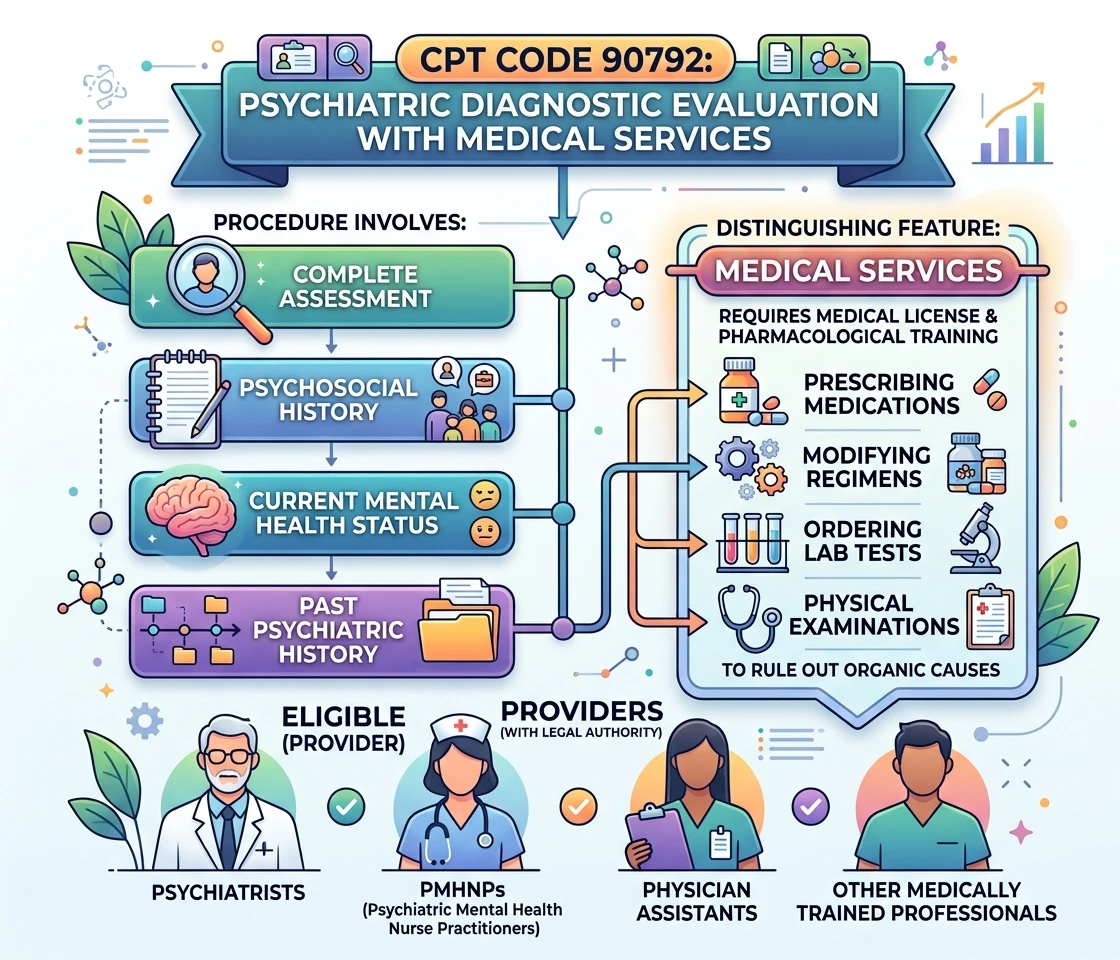
The official AMA CPT code 90792 description is a psychiatric diagnostic evaluation with medical services. This procedure involves a complete assessment of a patient’s psychosocial history, current mental health status, and past psychiatric history.
The inclusion of “medical services” distinguishes this code from other behavioral health assessments. Medical services involve tasks that require a medical license and pharmacological training. Examples include prescribing medications, modifying existing psychiatric medication regimens, ordering laboratory tests, and performing physical examinations to rule out organic causes of psychiatric symptoms.
Only providers with the legal authority to perform these medical services can bill this code. This group typically includes psychiatrists, psychiatric mental health nurse practitioners (PMHNPs), physician assistants, and other medically trained professionals.
Difference between 90791 and 90792
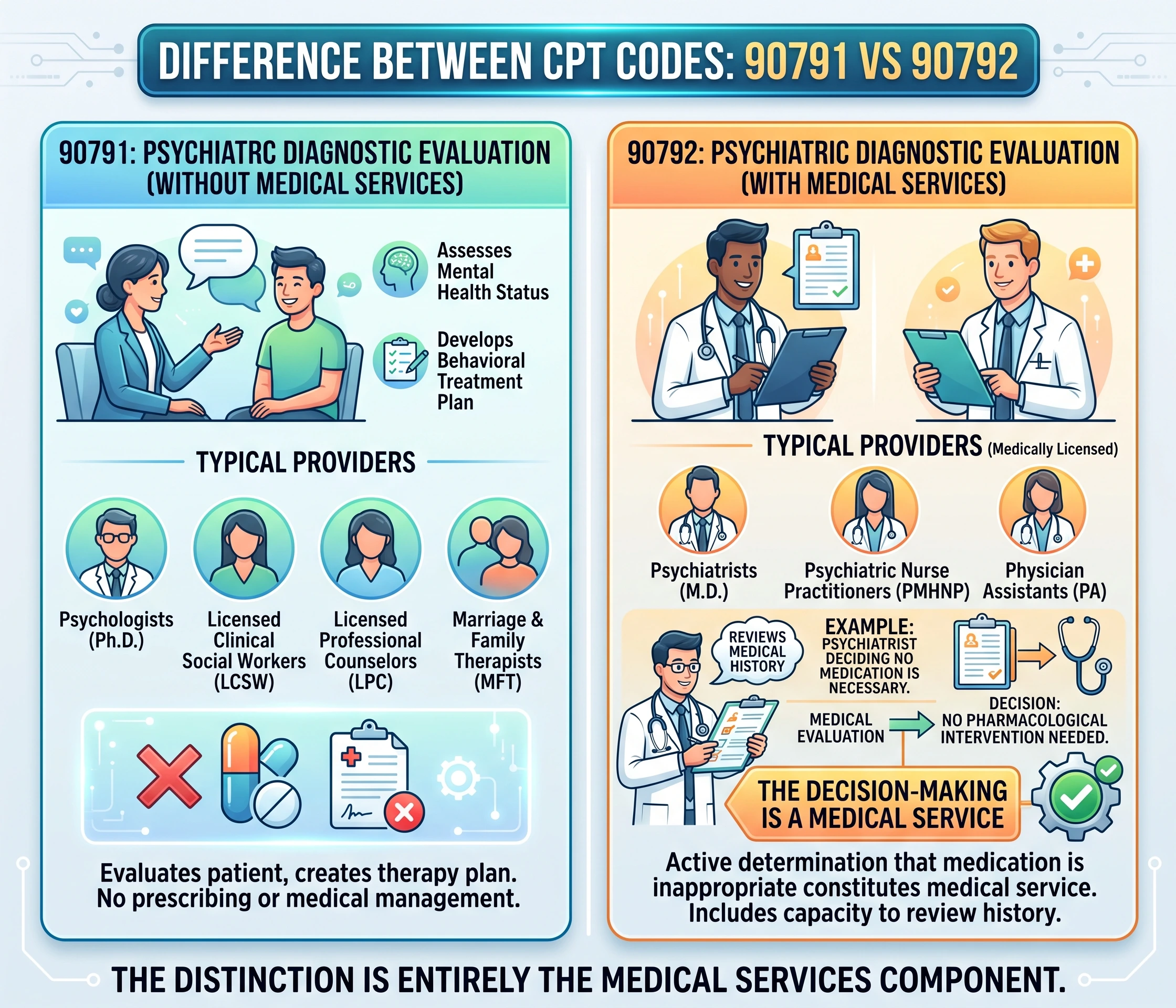
The distinction between 90791 and 90792 rests entirely on the medical services component.
CPT code 90791 describes a psychiatric diagnostic evaluation without medical services. Psychologists, licensed clinical social workers (LCSWs), licensed professional counselors (LPCs), and marriage and family therapists generally use 90791. These professionals evaluate the patient’s mental health and develop a behavioral treatment plan but do not prescribe medication or manage medical conditions.
If a psychiatrist evaluates a patient and decides no medication is necessary, the provider still bills 90792. The code accounts for the provider’s medical capacity to make that clinical judgment. The provider reviewed the medical history and actively determined that pharmacological intervention was inappropriate, which constitutes a medical service.
90792 documentation requirements
Auditors from the Centers for Medicare & Medicaid Services (CMS) and commercial health plans frequently review psychiatric assessment documentation. Claims for 90792 require a specific set of clinical elements in the patient chart. Missing any of these elements can trigger an audit failure and a demand for repayment.
A compliant 90792 professional claim must contain the following documented elements:
- Chief complaint: A clear statement detailing why the patient is seeking treatment.
- History of present illness (HPI): A chronological description of the development of the patient’s current psychiatric symptoms.
- Past medical and psychiatric history: A review of previous mental health diagnoses, hospitalizations, prior medication trials, and active non-psychiatric medical conditions.
- Social and family history: Information regarding substance use, living situation, occupational status, and any family history of mental illness.
- Mental status examination (MSE): Objective clinical observations detailing the patient’s appearance, affect, mood, speech, thought processes, cognition, and judgment.
- Medical assessment: Documentation of medical decision-making, such as reviewing lab results, discussing medication side effects, writing prescriptions, or evaluating the interaction between a psychiatric drug and a patient’s existing physical illness.
- Diagnosis and treatment plan: A definitive or provisional diagnosis using ICD-10 codes and a detailed plan for subsequent care.
90792 time requirements
Many billers ask how long a 90792 evaluation takes. Unlike evaluation and management codes, the 90792 CPT code time is not defined by strict numerical thresholds in the CPT manual.
The AMA classifies 90792 as an untimed procedure. Providers bill the code based on the completion of the required clinical components, not the duration of the visit. A straightforward evaluation for a highly articulate patient might take 40 minutes. A complex evaluation involving a patient with severe cognitive deficits and requiring interviews with family members might take 90 minutes. Both scenarios result in a single unit of 90792 on the claim form.
Despite the lack of a mandated time range, standard industry data shows that most psychiatric diagnostic evaluations take between 45 and 60 minutes of face-to-face patient contact. If a provider consistently bills 90792 for visits lasting only 15 minutes, insurance payers may initiate a chart review to verify that the provider is genuinely completing the extensive documentation requirements listed above.
90792 vs 99204 and 99205
Psychiatrists and PMHNPs have the option to use standard evaluation and management (E/M) codes instead of psychiatric-specific codes for new patients.
90792 vs 99204:
CPT code 99204 represents a new patient E/M visit requiring a moderate level of medical decision-making or 45 to 59 minutes of total time. Providers choose 90792 when the primary focus of the visit is a deep psychosocial assessment and the administration of a standardized mental status exam. Providers choose 99204 when the visit relies heavily on standard medical decision-making frameworks, or when they prefer to bill based on total time spent on the date of service.
90792 vs 99205:
CPT code 99205 represents a new patient E/M visit requiring a high level of medical decision-making or 60 to 74 minutes of total time. A provider might use 99205 instead of 90792 for an initial psychiatric evaluation if the patient presents with severe, acute exacerbations of a mental illness that pose an immediate threat to life, requiring intensive medical coordination, hospital admission planning, and high-risk medication management.
Many psychiatry practices prefer 90792 for initial visits because the documentation requirements align perfectly with standard psychiatric intake templates. E/M codes require providers to map their documentation to CMS’s specific medical decision-making grids, which were designed primarily for primary care and physical medicine.
Can you bill 90792 and 90833 together?
Medical billers frequently try to determine if 90792 and 90833 can be billed together. The direct answer is no.
CPT code 90833 is a psychotherapy add-on code representing 16 to 37 minutes of psychotherapy. According to the National Correct Coding Initiative (NCCI) guidelines, providers cannot bill psychiatric diagnostic evaluation codes (90791, 90792) with psychotherapy codes (90832 through 90838) on the same date of service.
If a provider conducts an initial psychiatric assessment and also provides 30 minutes of distinct psychotherapy during that same visit, they must change their coding strategy. The provider must bill an appropriate E/M code (such as 99204) for the medical evaluation and attach the 90833 add-on code to the E/M code.
Frequency limit for 90792
The frequency limit for 90792 dictates how often a provider can bill the code for the same patient.
Most Medicare administrative contractors and commercial health plans restrict 90792 to one unit per patient, per provider, per year. Behavioral health billing rules assume that a patient only needs one comprehensive diagnostic evaluation at the start of a treatment episode. Subsequent visits are billed using standard E/M codes (99212 through 99215) for psychiatric medication management, or psychotherapy add-on codes.
Exceptions exist. A provider may bill 90792 again for an established patient if there is a significant hiatus in treatment. Payers often define this hiatus as three years without a clinical visit. Additionally, if a patient presents with a completely new diagnosis or experiences a drastic change in mental status requiring a re-evaluation of their entire psychiatric history, the provider can bill 90792 again. The documentation must clearly justify the medical necessity of performing a new baseline evaluation.
90792 reimbursement and RVUs
The CMS Physician Fee Schedule determines the reimbursement rate for 90792 based on Relative Value Units (RVUs). Medicare calculates total RVUs by combining physician work, practice expense, and malpractice risk.
For 2024, the non-facility total RVU for 90792 is approximately 6.57. To determine the exact reimbursement amount, billers multiply this RVU by the annual CMS conversion factor. Because the conversion factor fluctuates slightly each year and Medicare adjusts payments based on geographic location, the exact dollar amount varies.
Commercial insurance plans establish their own fee schedules. Many private health plans peg their 90792 reimbursement rate to a percentage of the Medicare rate, frequently paying between 110 percent and 150 percent of the Medicare allowable amount.
90792 modifiers and Place of Service
Accurate psychiatric billing often requires specific modifiers and Place of Service (POS) codes to reflect where and how the evaluation occurred.
Telehealth billing:
Psychiatry relies heavily on virtual visits. If a provider performs a 90792 evaluation via a secure audio-video platform, they must append a modifier to the claim. The most common telehealth modifier is 95 (Synchronous Telemedicine Service Rendered via a Real-Time Interactive Audio and Video Telecommunications System).
Depending on the specific payer policies, billers must also change the Place of Service code. Instead of billing POS 11 (Office), billers use POS 02 (Telehealth Provided Other than in Patient’s Home) or POS 10 (Telehealth Provided in Patient’s Home).
Modifier 59:
Modifier 59 indicates a distinct procedural service. Providers rarely use this with 90792. An auditor will closely scrutinize any claim appending Modifier 59 to an initial psychiatric evaluation, as an initial evaluation usually encompasses all services provided on that date.
Interactive complexity:
If a provider conducts an evaluation under circumstances that complicate the delivery of care, they may use the add-on code 90785 (Interactive Complexity). A provider bills 90792 alongside 90785 if the evaluation involves patients with severe communication difficulties, requires the mandatory involvement of third parties such as child welfare agencies, or features high levels of emotional reactivity from family members that interfere with the assessment.
Accurate behavioral health coding ensures that providers receive fair compensation for the time and clinical expertise required to evaluate mental health conditions. By adhering strictly to the documentation requirements, understanding the boundaries between E/M codes and diagnostic evaluations, and applying the correct modifiers, billing teams can maintain compliance and reduce claim denial rates.